This Blog is dedicated to the Noble and Great horses in our lives and throughout history. Visit the land of the unicorns in Behind The Mist, the horse lover's fantasy for pre-teens to adults.


Order here now:


http://behindthemist.com/

Showing posts with label PATH. Show all posts

Monday, November 26, 2012

LORD LUDGER AND REBECCA HART...FUTURE UNICORN AND UNICORN RIDER!

I have spent most of the last seven months working for the Professional Association of Therapeutic Horsemanship, International (PATH.) This wonderful non-profit organization works to train and certify instructors and riding clinics that help people with all sorts of disabilities through Equestrian Therapy. Disabilities served include MS, MD, CP, vision and hearing, autism and even wounded wariors. As Ann Romney says in this television interview, Horses are truly a gift from God. They serve and help the able bodied as well as those who are struggling whether physically or emotionally. 
Here is the video from the interview in Times Square with Ann Romney and Para-olympian Rebecca Hart. I am amazed that Lord Ludger is so calm in such a crazy environment! (Sorry about the ads but I don't know how to get rid of them!)

http://gma.yahoo.com/video/parenting-26594265/wheelchair-bound-boy-scores-touchdown-31130203.html
 
I also found this article by Landsay Ysay McCall in the United States Para-Equestrian Association's newsletter that I am sure you will enjoy!
Ann Romney Awards Rebecca Hart and Lord Ludger 2012 USEF Para-Equestrian Dressage National Championship Trophy at USEF Dressage Festival of Champions
By: Lindsay Yosay McCall
Gladstone, NJ –June 26, 2012 – After earning the 2012 USEF Para-Equestrian Dressage National Championship title on June 13, 2012, Rebecca Hart, 26, of Unionville, PA, and Lord Ludger, owned by Jessica Ransehousen, were invited back to the United States Equestrian Team Foundation’s headquarters at Hamilton Farm.  In front of a congregation of press, spectators, and top Olympic Dressage athletes, Hart was awarded the perpetual Para-Equestrian Dressage National Championship trophy from presenter Ann Romney.  Romney has been a long supporter of Dressage, as an owner and athlete and she is a spokesperson for Multiple Sclerosis, which is one of the many diagnoses that specific Para-Equestrian athletes face.
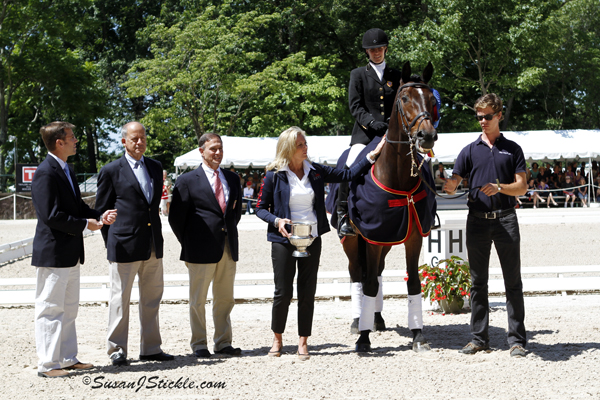
Photo Credit: Rebecca Hart receiving 2012 USEF Para-Equestrian Dressage National Championship award from Ann Romney during the 2012 USEF Dressage Festival of Champions. Photograph taken in Gladstone, NJ (c) Susan Stickle at SusanStickle.com.
In the moment that Rebecca Hart was awarded the 2012 USEF Para-Equestrian Dressage National championship trophy, she felt honored and humbled to represent the sport she has advocated for since 1998. Hart will add this National Championship to a list of accomplishments that she has achieved since 2003. In 2003 and 2007 she represented the U.S. at the Para-Equestrian World Championships, in 2006, 2008, 2009, and 2010 she won the USEF Para-Equestrian Dressage National Championship and earned the reserve championship in 2010. In 2008 she represented the U.S. at the Beijing Paralympics, and in 2010 she represented the U.S. again at the Alltech FEI World Equestrian Games.
Hart expressed, “I have been asked how it feels to have won the National Championship five times.  My answer is that it feels great, but I didn’t win this alone.  It takes a village to compete on this level and this win belongs to everyone who has ever helped me to get this point; From the person who offered the smallest word of encouragement, to family, friends, coaches, and corporate sponsors. I was truly honored to be asked to come back for the awards ceremony and presentation at the able-bodied USEF Grand Prix National Championships and selection trials with Ann Romney.  It is fabulous for Dressage to be brought into the limelight and in conjunction, Para-Equestrian Dressage.  Gladstone is steeped in history and to have my sport included in that history is truly special.  Mrs. Romney was so gracious as a presenter.  It was inspiring to have Mrs. Romney present this award because not only is she herself a fellow equestrian, but she also knows what it means to work with physical challenges.”
In 1998, Ann Romney was diagnosed with Multiple Sclerosis.  As an alternative to her mainstream treatments she began participating in Dressage. As with many equestrians, she jumped head first into the equestrian sport and never looked back. In 2005 she earned her USDF Silver Medal and in 2006 her Gold Medal. While working with trainers Jan and Amy Ebeling she developed a desire to achieve the top of the sport.  In 2012 at the USEF Dressage Festival of Champions her horse Rafalca, co-owned by Amy Ebeling and Beth Meyers, earned the third position with rider Jan Ebeling on the 2012 USEF nominated entries for the United States Olympic Dressage Team.
As Para-Equestrian Dressage and able-bodied Dressage intertwined at historic USET Foundation headquarters in Gladstone, NJ property, spectators began to learn more about the sport of Para-Dressage. Rebecca Hart trains week in and week out while she maintains a full-time job in corporate at the Starbucks Coffee Company.  She trains with Para-Dressage Chef d’Equipe and prominent Event rider Missy Ransehousen, alongside Olympian Jessica Ransehousen at Blue Hill Farm. Hart was born with Familial Spastic Paraplegia, a genetic disease that causes muscle wasting and lack of control from the waist down. Her ability to overcome obstacles has transformed her into an award winning international athlete in both Para-Dressage and able-bodied competition. In the future Hart hopes to reach the top of the Dressage discipline. On June 19, 2012 Rebecca Hart was named to the top of USEF Nominated Entry for U.S. Para-Equestrian Dressage Team for the 2012 Paralympics.
Read about the Noble and Great Horses in the fantasy Trilogy: The Mist Trilogy. 
Order your own AUTOGRAPHED copy of Behind the Mist and the soon-to-be-released Mists of Darkness here: www.behindthemist.com 
Also available wherever books are sold!

Wednesday, March 21, 2012

THERAPY HORSES EARN THEIR HORNS!


Staff Sgt. Aaron Heliker riding with Rainier Therapeutic Riding founding Debbi Fisher.

I have just started a job with PATH, International: Professional Association of Therapeutic Horsemanship. It is in Denver and is the certification and training organization for the many wonderful horsemen around the country who are helping children and adults find valuable therapy through horses. A friend sent me this article written by Nancy Bartley for the Seattle Times. I know you will find it heartwarming. These horses and horsemen who help our injured service men are heroes...truly some of the "NOBLE AND GREAT" ones, as I call them in Behind the Mist.

Seattle Times:
by Nancy Bartley:


After six tours of duty in Iraq and Afghanistan, Staff Sgt. Aaron Heliker's luck ran out.

A roadside bomb left him with third-degree burns, a traumatic brain injury and nerve damage to one leg. But the unseen wounds became the most disabling of all.

The 27-year-old who rode motorcycles, was a whiz at auto-body work and had wanted to be a soldier since he was old enough to ask his mother to "buy some army pants" could no longer tolerate being around people.

He was anxious, hypervigilant, expecting attack. Memories rushed in of his last tour in Afghanistan, the five-hour attack by insurgents his convoy fended off, the soldier he found bleeding to death but was unable to help.

To block out the memories and the surges of anxiety that made him feel always ready for battle, he began to drink. He was diagnosed with post-traumatic stress disorder (PTSD) and sent to a lockdown mental-health facility for veterans.

Faced with overwhelming physical pain, afraid of being close to anyone, and so mired in despair that he could see no hopeful future, Heliker didn't want to continue living.

Then he met Fred.

A white Frederiksborg gelding, Fred is one of the horses in Debbi Fisher's Rainier Therapeutic Riding program in Yelm, where servicemen are matched with horses they learn to groom and eventually ride.

"I really liked him so I postponed my death for a week," Heliker said. "In an office I feel cornered but out here (at the farm) I feel at peace."

Horses are ideal partners for traumatized service members because "they're kindred spirits," Fisher said, and have similar fight-or-flight reactions to perceived threats.

Training a horse not to jump away at a blowing piece of paper, for example, becomes a model for the soldier's own life. Fisher takes 75 soldiers a year — both active-duty and veterans — without cost to them or the government.

When it comes to helping with rehabilitation, equine-assisted therapy has become well known across the country. Texas' Horses for Heroes started in 2007 as a model, and nationwide a number of groups have followed, Fisher's included.

Search for purpose

Fisher, 53, has spent 40 years riding and training horses. After her first husband, an Air Force pilot, died in a car crash in 2006, she felt lost.

Seeking a purpose, she knew there was a need for helping soldiers with physical and emotional difficulties, and had heard of the Horses for Heroes program. The idea of starting a program took off after she married Bob Woelk, who became the co-founder.

The program was just what Heliker needed. Nothing else had worked, he said, not treatment at Walter Reed National Military Medical Center outside Washington, D.C., not therapy at a clinic in Texas, not the lockdown PTSD treatment facility in Oregon — not even his beloved service dog, Chopper, his companion to help with anxiety.

Fred's ability to mirror Heliker's own emotional state, requiring him to calm himself in order to do as little as brush Fred, has made it possible for Heliker to get used to staying in control.

Not long after meeting Fred last June, Heliker canceled his plans to die, and over the course of nine months went from taking 42 pills a day to four.

As far as Dr. Murray Raskind, a psychiatrist at the Veterans Affairs Puget Sound Health Care System in Seattle, is concerned, programs that get service members exercising and out among people are excellent.

"All of those things are good," he said. "Physical exercise relieves depression, anxiety and stress. It gets people out of their isolated state from being in their 'bunkers' ... and gets them interacting with other human beings and (in the case of the riding class) connecting with an animal. Many people feel more comfortable around animals."

But, Raskind said, it's not a substitute for conventional therapy.

Fisher started her program in 2010, the same year Madigan Army Medical Center closed its PTSD program, and when 18,000 service members were returning to Joint Base Lewis-McChord from Iraq and Afghanistan.

Soldiers are referred to Fisher's program by the Warrior Transition Battalion at the joint base.Other recreation programs are offered as well, but the riding program is among the most popular.

At Rainier, each rider starts slowly by learning to groom the horse, leading it and eventually riding.

Sessions last eight weeks and run four times a year. Participants can repeat sessions and remain in the program as long as they want. Ninety percent are active-duty soldiers, the rest veterans. Some stay on as volunteers, including Heliker.

"Through this equine-therapy program, I've seen soldiers building relationships, confidence and their self-esteem," said Phyllis Lang, an occupational therapist with the Warrior Transition Battalion.

Fisher donates the use of her eight horses and operates in donated arenas. She says the program costs $700 per rider, which she raises through donations.

Class awaits

Two times a week, Fisher arrives with a caravan of horse trailers. Heliker and other volunteers help unload horses, saddle them and lead them into the arena with a class of waiting service members — many who have faced the worst of war but are now uncertain about the 1,200- to 2,000-pound animal before them.

Heliker, who has spent nine years in the Air Force, stays in a camper on base. Living in a barracks is uncomfortable right now because he feels safest when alone or with a few trusted people.

While he continues to take part in therapy through the Wounded Warrior Battalion, he volunteers much of the week — mucking stalls, feeding horses and helping other service members. On Wednesdays, he rides with the advanced class.

He knows how easy it is to go the way some older vets from the Vietnam era did — disconnecting from everyone. So he talks to one, Ed Wilus, who also rides in the program. Wilus tells him how he gave up a family and job and spent years avoiding his problems by drinking. He ended up living under bridges.

Heliker began building a relationship with Fred when he realized the horse needed to trust him or the animal wouldn't cooperate. On days when Heliker was angry, Fred reflected it. Heliker had to calm himself down to get the horse to work with him or face spending the afternoon chasing Fred around a field.

Gradually, Heliker grew calmer all day long, not only trusting the horse but also forming a close bond with Fisher, whom he regards as a second mother. He is also rebuilding his relationship with his mother, whom he shut out of his life after he was injured.

Sue Heliker, who lives in Grand Valley, Pa., said the son who had been the family clown disappeared on the battlefield, replaced by the lost soul she saw at Walter Reed in January 2011.

He had stopped talking to her about convoys along the dangerous Highway 1 south of Baghdad — the stories had become so familiar to her, she felt she had traveled the highway.

He had stopped speaking of July 4, 2009, his birthday, when he was the lead gunner on a convoy going over a mountain pass in Afghanistan and his group was ambushed and trapped by small-arms fire for five hours. He didn't even tell her he had suffered a small stroke on his sixth deployment.

So when he was hospitalized for PTSD at Walter Reed last year, his parents gathered around him not knowing how to make things better.

"Look at me, Mom, look at my eyes. I'm dead," Heliker told his mother.

"I looked at him and knew there was no way I could save him," she said.

When he ended up at Joint Base Lewis-McChord and was referred to the riding program, his mother wondered if it would do any good. But after just three months, she could hear the change in him over the phone.

"You sound so peaceful. You're like the boy you were before you went into the military," she said. "How does a horse do that?"

"When I'm around the horse, he reminds me of a giant puppy dog," Heliker said. "You can hug him. You can talk to him. ... It's just relaxing. There's no pressure, just you and your best friend."

Even though he's sad his military career is ending — he expects to be discharged soon — he's beginning to think of new possibilities, such as training to become a horseshoer. For the first time in a long time, he's thinking of the future, and of horses that will be in it.


SPECIAL NOTICE:


Behind the Mist is now available in ebook format!


Download it off Amazon's Kindle


Barnes and Noble's Nook


or