This Blog is dedicated to the Noble and Great horses in our lives and throughout history. Visit the land of the unicorns in Behind The Mist, the horse lover's fantasy for pre-teens to adults.


Order here now:


http://behindthemist.com/

Showing posts with label famous horses. Show all posts

Wednesday, December 20, 2023


 "The Stallion and His Peculiar Boy" is a historical fiction novel for young adults and adults combining the true story of the life of Witez II with a fictional character who becomes his groom. The twelve-year-old boy lives in the little village of Hostau, Czechoslovakia, where Witez was taken by the Nazis after he was stollen out of Poland. The young boy suffers from Autism at a time when little was known about the condition. As the story unfolds, the boy learns to interact with the world as he learns to work with the horse. The book has been the winner of seven literary awards: The Purple Dragonfly Award, Readers' Favorite Award, The FAPA President's Award, The CIPA Evvy Award, The Global Book Award, The Wishing Shelf Book Award, The Maincrest Media Award, as well as being the #1 Best Seller on Amazon.  

I want to share some of the information I learned about Witez and the Polish Arabian blood lines: 


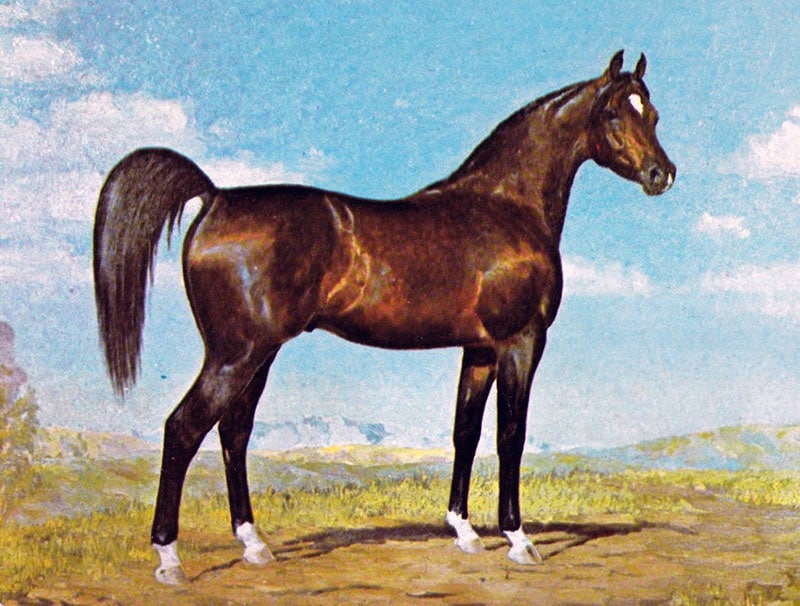
Witez II, the famed Polish Arabian stallion, left an indelible mark on the world of Arabian horse breeding and garnered international acclaim for his exceptional beauty, conformation, and athletic prowess. Born in 1938 at the Antoniny Stud in Poland, Witez II descended from a long line of esteemed Arabian horses known for their grace and endurance. His sire was the legendary Skowronek, and his dam, Ofirka, contributed to his impressive bloodline.

Witez II's reputation as a superior breeding stallion was solidified during his time at the Janów Podlaski State Stud, where he became an influential sire. His descendants went on to make significant contributions to Arabian horse breeding programs worldwide, enhancing the breed's quality and preserving its unique characteristics. Witez II's offspring were not only successful in the show ring but also excelled in diverse equestrian disciplines, showcasing the versatility that the Arabian breed is known for.

Beyond his influential role as a sire, Witez II achieved recognition for his own show career. Renowned for his stunning presence, he captured the attention of enthusiasts on both sides of the Atlantic. His accolades include championships at prestigious shows, such as the Salon du Cheval in Paris and the National Arabian Horse Show in the United States. Witez II's impact was not limited to the realm of horse shows; he became a symbol of the enduring beauty and grace associated with the Arabian horse.

Witez II's story is intertwined with the broader narrative of Polish Arabian horse breeding, which has consistently produced horses of exceptional quality and distinction. His legacy endures through his descendants, who continue to impress in various equestrian endeavors, carrying forward the tradition of excellence that Witez II epitomized. Today, the Polish Arabian horse community and enthusiasts worldwide celebrate Witez II as an iconic stallion whose contributions have left an enduring imprint on the history and heritage of Arabian horse breeding.


Get your own copy of "The Stallion and His Peculiar Boy" wherever books are sold. Autographed copies are available from the website: www.dancinghorsepress.com


Thursday, October 12, 2023

"FINDING FIONN" 

IS A NEW RELEASE COMING OCTOBER 17TH INSPIRED BY THE KIDNAPPING OF THE FAMOUS IRISH RACEHORSE SHERGAR!


On a cold, foggy night in county Kildare, Ireland, the famous racehorse, and Irish hero, Shergar was kidnapped. The next day, a phone call came in to his trainer with a demand for 2 million pounds. Shergar's owner refused to pay and the horse was never seen again. To this day, this mystery has not been solved. 

Shergar was the 1981 European horse of the year. He shocked everyone by winning the Epsom Derby in England by more than 10 lengths. 

Shergar was beloved by everyone who knew him and worked with him. After an extremely successful career as a three-year-old. He was retired back to his birthplace, the Ballymany stud in Ireland. As a four-year-old, he fathered many successful colts and fillies. But his promising career as a stud came to a halt on that fateful night in February 1983. 
Many theories abound as to who was responsible for his theft. Was it the Irish Republican Army (IRA) seeking funds to continue their war efforts? Was it a jealous competitor? Was it insurance fraud? 

No one knows. 

My new book, to be released on all sites on Oct. 17, 2023, takes the facts of the kidnapping and applies them to a fictional horse named Fionn MacCool. Because I am an author, I can create the ending to the story as I would like to have seen it happen. 

Autographed copies are available on the website: www.dancinghorsepress.com


Tuesday, November 29, 2022

THE STALLION AND HIS PECULIAR BOY


My new book "The Stallion and His Peculiar Boy" will be out in the spring! It is a Historical Fiction based on the life of the famous Arabian Stallion, Witez II. The professional reviews of starting to come in. Here is one from Readers' Favorite:

Review Rating:

5 Stars - Congratulations on your 5-star review! 


Reviewed by Kimberlee J Benart for Readers’ Favorite

The Stallion and His Peculiar Boy: Based On the Life of the Famous Arabian Horse Witez II

is a work of historical fiction by M.J. Evans set in the period 1943 - 1965. Teodor is a 

non-communicative autistic boy living in Hostau, Czechoslovakia, where the finest 

captured horses from all over Europe are sent to a Nazi breeding farm. Teodor meets 

Witez, the two bond immediately, and he becomes a worker at the farm where he trains as 

Witez’s groom. Later, as the war ends and the horses come under the threat of being 

slaughtered for food by the advancing Russian Army, some German officers ask the United 

States Army to rescue the animals and take them out of Czechoslovakia. Soon, Teodor 

accompanies Witez to America in the adventure of a lifetime.


In The Stallion and His Peculiar Boy, M.J. Evans gives us an entertaining and informative 

account of the Polish horse who became a premier stallion in the pedigree of the Arabian 

breed in the United States. Told in part through the fictional character of Teodor and 

sensitive to his therapeutic and devoted bond with Witez over the years, it blends the 

suspense of a World War II military rescue operation with the subsequent challenges of 

resettlement in a new land with new owners. The narrative is engaging and moves at a 

good pace. The choice of an autistic protagonist adds a special dimension, and Teodor 

is both relatable and believable. Suitable for young adult and adult readers, this story 

is sure to please anyone who enjoys good historical fiction.

Thursday, August 18, 2022

I REMEMBER FURY!


From 1955 to 1960, NBC televised a western titled: "Fury." My parents didn't get a T.V. until 1956, but once they did, I HAD to watch every episode of the story about the wild stallion that only one boy could tame and ride. I dreamt of being that boy. 


Fury was an equine actor. He was thought to be the most popular horse in the country during the 1950s. He held the title role on the popular Saturday morning television series which was also broadcast around the world. Additionally, he starred in several movies: "Black Beauty," "Brave Stallion," "Gyspy Colt," "Wild is the Wind," "The Return of Wildfire," and "Giant" with Elizabeth Taylor.

He won several Patsy Awards. The Patsy Award was created in 1939 by the Hollywood office of the American Human Society. It was created to honor a horse that was killed on set while filming a movie. It stands for "Picture Animal Top Star of the Year." 

Fury was born in 1943 in Missouri. The Saddlebred Stallion was named Highland Dale. He died in 1972, at the age of 29 in California and is buried there. He worked only four months of the year. He earned his owner/trainer Ralph McCutcheon $500,000 in the eight years he performed. He was paid $1,500 for each Fury episode. By the time Highland Dale retired, he ranked second only to Lassie in net earnings by an animal actor. 


Wednesday, February 3, 2021

Bold Minstrel - A Heroic Horse For All Seasons!


 Bold Minstrel ridden by owner William Haggard at Devon in the hunter classes.

    When I was growing up in Lake Oswego, Oregon, I purchased a dapple gray 3/4 Arabian with my own money. Because Tai was such a wonderful horse, dapple-gray became my favorite color! As a result of my love of dapple-gray horses, I want to share some information with you about a fabulous, famous horse named Bold Minstrel. 
    Bold Minstrel is the only horse in history to medal in three Pan American Games and one Olympic Games in two different disciplines: Eventing and show jumping. This amazingly talented thoroughbred was born in 1952 (or 1951 depending on the source,) in Camargo, Ohio. He was purchased by William Haggard as a five-year-old. Haggard loved riding him in hunter classes and eventing. (Dressage, cross-country jumping, and stadium jumping.) Because he was such a big, stocky horse, Billy nicknamed him "Fatty." By jumper standards, he was quite fat. 
    Haggard began showing Fatty in hunter classes, his flashy looks and beautiful form winning him numerous championships. Then Haggard switched to eventing, earning a spot on the U.S. Team in the Pan Am Games in 1959 where the team came home with the silver medal. Four years later, the team came home with the gold in San Paulo, Brazil. Between the two games, Haggard and Bold Minstrel still had fun winning in the hunter ring. 
    Surprisingly, the team was not selected for the Olympic Games in Tokyo. However, when J. Michael Plumb's horse, Markham, had to be euthanized on the flight over, Haggard loaned Bold Minstrel to the veteran rider. Bold Minstrel was flown over to Japan just two weeks before the competition. You and I might be awfully nervous about riding a new, strange horse in the OLYMPICS after only two weeks of training.  The talented horse caught the eye of the famous Olympic Equestrian, William Steinkraus. For several years, Steinkraus tried to convince Haggard to compete with the horse in Jumpers, or let him do it. So, when the horse was twelve years old, Haggard loaned him to Steinkraus.


Bold Minstral being shown by Bill Steinkraus

    Steinkraus remarked that the horse was not only brave and talented, but had a mind of his own when it came to completing a jump course of enormous jumps.Nothing made owner William Haggard more proud than when Fatty broke the world record in the old Madison Square Garden, winning the International Puissance by clearing the 7'3" wall!


Fatty was retired from competition at the age of 18. After that, he returned to the Haggard farm where he enjoyed a life of Fox Hunting. Bold Minstrel has been inducted into the National Show Hunter Hall of Fame. 


Learn about another famous horse: "PINTO" the holder of the record for the longest horseback ride in history!
Click here to get the book about him from Amazon: 
Click here to get the book from Barnes and Noble:


Tuesday, November 7, 2017

TRAIL GUIDE THE OLYMPIAN

Some horses get to enjoy a variety of careers in their lifetimes. Such was the case with Trail Guide. He went from a cavalry horse to a big-(and mean REALLLLLY big)time show jumper.


Trail Guide was a two-time Olympic Showjumper. The beautiful thoroughbred was out of Trailoka, a mare who was also an Olympic mount, competing in 3-day eventing.

The famous rider, Hugh Wiley rode Trail guide to an 11th place finish in the 1956 Olympics. When he turned 21, Trail Guide led the US Olympic team to a team Silver Medal while being ridden by Show Jumping legend, Frank Chapot during the 1960 Olympic Games in Rome Italy.

Trail Guide won numerous championships at the top shows. He was ridden by the best riders: Hugh Wiley, Frank Chapot and Bill Steinkraus.
Trail Guide's life ended, shockingly, in 1960 in the show ring of the National Horse Show. He crashed into a five-foot fence and broke two vertebrae in his neck. A curtain was pulled around him and he was euthanized right there in the arena, surrounded by the jumps that he loved and the people who loved him.

Trail Guide was inducted into the Show Jumping Hall of Fame in 1995.
Show Jumping Hall of Fame


Christmas is coming and you and your horse-loving friends and family will love my new fantasy series: The Centaur Chronicles.  The first two of the four books are available now.
This AWARD-WINNING Series is receiving both fabulous critical reviews and national and international awards for middle-grade and young adult fantasy. Please visit my website and order an autographed copy for a Christmas or Holiday Gift.

Click Here: www.dancinghorsepress.com

Also available wherever books are sold.

Wednesday, July 19, 2017

INCITATUS-THE HORSE WHO BECAME A SENATOR

As I watch all the incompetence in Washington DC, I think about all the manure that needs to be shoveled out of that town and those government buildings. This reminds me of another time when a ruler was dealing with a Senate that was not functioning and a horse who became a Senator!


Caligula was the emperor of Rome from AD 37 to AD 41. He is one of the better known emperors as he was quite eccentric and pulled some pretty funny stunts. He spent his short term, before he was assassinated, feuding with the Roman Senate. He strove to increase his power and expand the Roman empire into Northwest Africa. But his most memorable actions involved his favorite horse, Incitatus.

Incitatus means "Swift" in Latin and was the emperor's favorite horse. The white stallion was so beloved by Caligula that he was housed in a marble stall and ate from a manger made of ivory. He was draped in a purple blanket. At that time, purple dyes were very rare and hard to come by. Therefore, purple fabric was reserved for royalty and signified great social status. Records have noted that Incitatus was fed oats laced with flecks of gold. Another historian recorded that Incitatus had an elaborate jeweled collar. I don't know if they meant a halter, bridle or a Breast Collar.

History records two funny incidents involved Caligula and Incitatus. The soothsayer for Caligula's great uncle prophesied that Caligula had no more chance of becoming Emperor than of riding a horse across the Bay of Baiae that separated the towns of Baiae and Puteoli. So in 39 AD, Caligula ordered grain barges to be connected front to back clear across the bay. He then rode Incitatus across the floating bridge from Baiae to Puteoli!

The other incident involved Caligula's continual conflict with the Roman Senate. He was so angry with the lack of cooperation he was getting from the Senate that he appointed Incitatus to be a Senator and possibly also a Consul. In ancient Rome, two consuls were elected annually to be the chief magistrates who jointly ruled the republic. This move has caused some to claim that Caligula was insane. I think he was pretty smart to call attention to the manure that was being shoveled out of the Senate. I think President Trump should get a horse!

This stunt is what made Caligula famous. Many movies and works of art have picked up on this story.

In  addition, it has been the brunt of lots of jokes.


I can sympathize with Caligula. I'll bet my horses could get more done than our current batch of Senators!


Thursday, August 4, 2016

THE LEGEND OF BABIECA


Perhaps the day of the war horse is gone but their legends live on. This is true of Babieca (there are numerous spellings!) the mount of the famous, or "infamous" depending upon the source, El Cid.

El Cid who lived from approximately 1043 to 1099, was the son of minor nobility in medieval Spain. He was raised in the court of King Ferdinand the Great and was a servant to the king's son. He became a renowned, feared and beloved war hero as he battled for the Spanish cause of expanding their territory. To this day, El Cid, full name Rodrigo Diaz de Vivar, is a Spanish folk hero and national icon. He is the subject of numerous plays, poems, and paintings.


But what of the horse? El Cid's favorite horse was Babieca, a white Andalusian Stallion. No one really knows the history of how they came to be battle partners. One story has it that El Cid was offered his choice of any of the horses in the herd of Andalusians by his godfather, a monk at a Carthusian monastery.  He chose the littlest, weakest one. His godfather thought it was such a poor choice that he exclaimed "Babieca!" which means "Stupid." 

Another story is that El Cid was given the horse by King Sancho when El Cid was challenged by another Knight to become the king's champion. The story goes that Babieca was bred and raised in the royal stables in Seville and was a highly trained and loyal war horse when El Cid got him.

Whatever the truth, El Cid loved the horse and even requested that they be buried together. 

A little side note: Did you know that our modern day discipline of Dressage has its origins in the training of War Horses?


Check out my new website for my books: www.dancinghorsepress.com

Monday, April 25, 2016

SNOWMAN-The $80 Champion

 In 1956, a riding instructor by the name of Harry de Leyer from Long Island, New York went to a horse auction in search of a school horse. He was late (Maybe the traffic in New York was terrible at that time, too!) and the only horses remaining were those being loaded on the truck bound for the slaughter house. One horse caught his eye, a skinny, gray, Amish-bred plow horse. He took a chance and bought him for $80.


De Leyer knew horses and horsemanship. He fattened up the gelding, and started using him to teach riding lessons. The horse had been born in 1948, bred by Amish farmers, and was a mix between various breeds including draft horses...making him an original American warm blood! I don't know why he was sent to auction at just the age of eight. However, the horse had tremendous jumping talent that was only discovered by de Leyer after he sold the horse to a neighbor and Snowman kept jumping over fences to get back home.

De Leyer started training him to be a show jumper and started winning prestigious shows just two years after being saved from slaughter. Snowman went on to be the United States Open Jumper Champion in 1958 and 1959. He would jump anything...even another horse:

Snowman had such a wonderful temperament that he even won the leadline class and the open jumper class in the same show. For those who don't know, the leadline class is for children under 7 who show their equitation skills at a walk and a trot while their horse is being led and controlled  by an older child or adult. It is amazing that Snowman was so calm that he could be a leadline horse AND a show jumper. The horse was well-loved by the entire de Leyer family as is evidenced by this picture:
Snowman died in 1974 after having gained the love of those who knew him as well as international fame. He even went on the Johnny Carson show. He has been made into two different styles of Breyer horses and is the subject of a best-selling book and maybe even a movie. He was inducted into the Show Jumping Hall of Fame in 1992.


Tuesday, January 26, 2016

THE BYERLEY TURK

Many of you are probably aware that the wonderful modern thoroughbred is descended from three Arabian horses. One of them was called the Byerley Turk. Now days, the horse racing industry is very picky about recording bloodlines but no one really knows the real bloodlines of the Byerley Turk and if he was a purebred Arabian or not. He was a spoil of war and such a magnificent stallion that, when the British defeated the Turks at the Siege of Buda in 1688, a British captain by the name of Robert Byerley took the horse from a Turkish officer. (I know, I know, that is NOT very nice but war is NOT nice.)

The Byerley Turk continued to serve as a war horse but for the other side! After the war, he was retired and put out to stud. With the lovely mares he was bred to, he produced many great race horses who carried on his bloodlines, whether they were pure or not!

GREAT REVIEW FOR MY NEW NOVEL:
IN THE HEART OF A MUSTANG

The following review is from Author, blogger and horsewoman SHARON MINER. I so appreciate her wonderful evaluation.

The book, In the Heart of a Mustang by MJ Evans, is the type of horse novel I love to read, one with an interesting protagonist, an endearing theme without being preaching, a detailed setting and cast of characters the reader won't forget.

When 15 year-old Hunter learns that his mother has lied to him about his father, he retaliates by running away and making the wrong sort of friends on the street. To avoid trouble with the court, his grandfather suggests they send Hunter to a boy's ranch in Arizona and grandpa will pay for his stay.

Hunter is not impressed with Promise Ranch at first, and especially when he meets the other at-risk boys and staff including the head cowboy, a horse trainer for the wild mustangs that the ranch adopts. But slowly he learns about life lessons, even after a personal tragedy.

This is a fantastic story for everyone, not just horse lovers. It's one of the best coming of age novels I've ever read!

See more of her reviews here: horsebookreviews.blogspot.com

You can get In the Heart of a Mustang on my website: dancinghorsepress.com , on amazon and Barnes and Noble. Print and ebook versions available.


Sunday, November 15, 2015

COPENHAGEN IN THE BATTLE OF WATERLOO


Quite a while ago, I wrote a post about Napolean's horse, Marengo. As you probably remember Marengo is said to have been the favorite horse of the French emperor. Interestingly enough, it is very possible that he and one of his cousins, Copenhagen, or so it is said, faced each other in a terrible battle. On Sunday the 18th of June, 1815, near Waterloo in present-day Belgium then part of the United Kingdom of the Netherlands, Napoleon's French army lead by Napoleon, was defeated by a coalition of two armies, one led by the Duke of Wellington riding Compenhagen.


Where there is some doubt about Marengo's authenticity, Copenhagen was very real. He was a stallion with a rather mean temperament. When the Duke of Wellington returned from his victory at Waterloo, he gave Copenhagen a celebratory pat on the rump. Copenhagen responded by trying to kick the Duke in the head! Luckily for both of them, he missed. It would have been a really bad day for the Duke to survive a day of bullets and cannon fire only to be killed by a kick in the head from the very horse that carried him through the battle!

The story is that Copenhagen became much milder in his old age and became a favorite with the ladies who wanted tail hair to make bracelets. (By the Way: this is something that is going on today and some people in Colorado have actually come out to their barns to find that someone has snuck in during the night and cut off their horse's tail! So, don't buy those horse hair bracelets unless you know where the hair came from!)

Copenhagen was so well regarded that, after he died, his head was cast in bronze and put on display at Wellington College.


CHRISTMAS IS COMING!
Books make the best Christmas presents and Horse stories make the best books!
GO TO 
and check out my new book:

In the Heart of a Mustang

or my popular fantasy trilogy:

Behind the Mist,
Mists of Darkness
and
The Rising Mist

Autographed copies available from the website!

Sunday, September 27, 2015

CARDIGAN BAY SETS THE PACE IN CELESTIA!

Cardigan Bay is another famous standardbred pacer and can legitimately claim to being one of the world's best race horses in any style of racing! He was the ninth horse to win $1 million U.S. dollars...the first 8 winners were all thoroughbreds.

Cardigan Bay was born in New Zealand on the first of September, 1956. He was beloved by his owners, trainers and riders and affectionately called Cardy. After winning 29 of 47 races in New Zealand and Australia, he was purchased for $100,000 by a syndicate  in the U.S. with the agreement that he would be retired in New Zealand. He raced in the U.S.from 1964 through 1968.

The plain bay colt, crossed the $1 million mark at the Freehold Raceway in New Jersey and was retired right after that in a Sept. 1968 ceremony in Yonkers, New York. Before returning to New Zealand where he spent the rest of his life on a stud farm, Cardy actually appeared on the Ed Sullivan Show...I know, most of you weren't alive for that Sunday night show but I was. (And I watched the Beatles 1964 performance and screamed all the way through it!)
Below is an interesting Youtube video of one of his races. Watch closely as, right at the end on the back stretch, there is a crash and horses and sulkies and drivers go everywhere. One driver flies through the air and lands in the lap of another driver and the horse carries both of them across the finish line!


Cardigan Bay was so famous and such a national hero in New Zealand that they actually made a postage stamp with his image on it!
Cardigan Bay died peacefully in his sleep in March of 1988 at the age of 31. Well, at least that was the official word!

To learn what happens to the noble and great horses after they die, peacefully or not, read The Mist Trilogy. Check it out on my new website: www.dancinghorsepress.com
The Mist Trilogy is a 2014 Gold Medal winner of the Mom's Choice Award.

Tuesday, July 14, 2015

ADIOS-THE FASTEST PACER IN CELESTIA!

When my husband and I were newly weds, we drove across the country from Oregon, where we were married, to New Haven, CT where Tom was a student at Yale and I was going to start my teaching career at North Haven High School. We had taken the long route through Canada before cutting down into upstate New York. It was late at night and without even a moon to light the way, all was dark as we drove across the farm lands. Eventually, the sky up ahead was glowing with bright lights. When we arrived at the source of the light, we discovered that they were illuminating a horse racing track. Going around the oval were Standardbreds, pulling sulkies. Having never seen a harness race before, we pulled off and went to watch. It was fascinating and so fun.

I have mentioned before that, as a child, my favorite books were anything written by Marguerite Henry. She wrote one book about harness racing titled "Born to Trot". That was my only exposure to harness racing.

So, today, I decided to go back to my usual theme of "Noble and Great Horses" and write about one of the greatest harness racers: the great champion and outstanding sire, ADIOS!
 Adios was born on January 3, 1940, the son of Hal Dale and the mare Adioo Volo. He was born at Two Gaits Farm in Carmel, Indiana. He was trained and driven by Frank Ervin. For a while, he was owned by Harry Warner of the Warner Brothers film studio. During his racing career, he won multiple world championships. His pacing record at the Shelbyville Indiana fair stood for 43 years!
In 1948, Adios was bought by harness racing driver Delvin Miller. Miller brought him to his Meadow Lands farm near Washington, PA, where he stood at stud. While he was a great racer, Adios was even a better stud and is considered by many to be the greatest sire in harness racing history. He sired eight "Little Brown Jug" winners and his sons, Adios Butler and Bret Hanover, both became winners of the Triple Crown of Harness Racing for Pacers. Before he died, Adios had sired 589 offspring. His name is found on consumer products and harness horse equipment. He even has a golf club in Florida named after him!


The Triple Crown of Harness Racing for Pacers are:
Cane Pace, held at Tioga Downs in Nichols, NY
Little Brown Jug, held at the Delaware County Fair in Delaware, Ohio
Messenger Stakes, held at Yonkers Raceway in Yonkers, NY

There is a different Triple Crown for Trotters.

All North American Harness races are restricted to Standard Bred Horses.  But the races are divided into two specific gaits: a trot or a pace.

 There is a big difference between pacers and trotters. A trot is a two beat diagonal gait, like my Hanoverian, Jazz, does and that we English riders ride either posting (rising up and down) or sitting. The trot of a standard bred is faster than the gallop of the average non-race horse and has been clocked at over 30 miles per hour.

The pace, on the other hand is a lateral two-beat gait. In the pace, the two legs on the same side of the horse move forward together. Some horse naturally prefer to pace. This gait is generally not comfortable to ride as the rider is thrown from side to side. The pace of the Icelandic Horse is one exception. But the pace is even faster than the trot in a harness racing horse.

This famous set of pictures shows that there is a moment in the pace (as well as the trot) when all four of the horse's feet are off the ground.

READ THE AWARD WINNING FANTASY 
"THE MIST TRILOGY"
BEHIND THE MIST, MISTS OF DARKNESS AND THE RISING MIST
Autographed copies available on the website:
www.themisttrilogy.com

Also available wherever books and ebooks are sold.

Tuesday, February 4, 2014

JOE CODY: CREATING A REINING DYNASTY IN CELESTIA


Not all noble and great horses are thoroughbred race horses or movie/t.v. stars. Take Joe Cody for example. He is arguably the most famous and influential American Quarter Horse ever! Little Joe was born on Tom Cochran's ranch in Buckholt, TX in 1952. As a yearling, he was purchased by Robert F. Roberts of Tyler, TX. With Doc Spence in the saddle, he earned the AQHA Championship in reining in 1955...just a 3 year old! 

He was eventually purchased by the well-known breeder, photographer, magazine publisher (Practical Horseman and Performance Horseman) and movie producer (The Horse America Made,) C.T. "Tom" Fuller of Catasauqua, PA. In 1964, Tom moved the stallion to Willow Brook Farms where he became the basis for his quarter horse breeding operation. This was all thanks to his daughter's love of horses I might add and a groom who brought two of Joe's daughters to the ranch. Tom decided he loved the mares so much, he might as well own their father.

Joe Cody is considered the founding sire of Reining horses even though he won championships in both reining and cutting. A little side note, just before Tom bought him, he was invited by the government of Bermuda to perform reining and cutting at their agricultural fair and he stunned everyone with his performance.

Both Joe Cody and C.T Fuller have been inducted in the AQHA Hall of Fame. Joe Cody died in 1989 at the age of 37 and is buried on Willow Brook Farm. 

A little commentary: Tom Fuller's father had purchased the land for the farm in an effort to keep the area rural and to stop development and industrial encroachment. Currently, much of the farm is now under the airport when the land was taken (stolen) by the government claiming eminent domain! 

GREAT NEWS! I have just finished writing my third equestrian trail guide book for Colorado: Riding Colorado III - Day Trips and Over-Night Trips With Your Horse.  YES- Over-Night Trips! So, all you Colorado wanna-be's who have always dreamed of riding your horse in the Colorado Mountains can find out where to come! I'll let you know when it is published. For a sneak preview, here is the picture for the cover: 
Start planning a summer trip to Colorado!

Monday, August 12, 2013

POKER CHIP-A TRAILERING VICTIM


I am continuing my focus on trailering. My intent is not to keep you from trailering your horse but rather to make you aware of how careful you need to be when you do so your precious cargo, that is completely dependent upon you, won't get hurt.

Poker Chip Peake is another noble and great horse that  has surely earned his unicorn horn by now. He was an iron grey gelding by the famous quarter horse stallion, Driftwood. He was a dream horse for cattle ropers that competed in the tie-down event. Not only did he have perfect confirmation but he had great "cow-sense" as well. He could read a cow's thoughts before the cow even had that thought! He was also perfect at what cowboy's call "working the rope." He was able to keep the rope tight and the cow still so the roper could tie up those three legs quickly. Sadly, in 1963, Poker Chip was obediently riding in a trailer that overturned on an icy road. As a result, he developed calcium deposits on his hip which ended his career. He was retired  by his owner, Dale Smith, to a ranch near Chandler, AZ in 1966. Poker Chip was inducted into the Pro Rodeo Hall of Fame in 1979.

While I do not know the cause of the accident that injured Poker Chip other than icy roads, I just remind you to be careful when trailering your horse. Especially remember to allow a lot of space between you and the car in front of you because you can not stop as fast when pulling a trailer than you can without it. It drives me crazy when I try to allow plenty of room between me and the next car and cars continually pull in front of me! But, what can you do? Just back off some more to save your horse.

Send me the story of your Noble and Great Horse to: mjevansbtm@gmail.com.

If you love to read, order Behind the Mist and Mists of Darkness, the first two books of the Mist Trilogy. Just click here for a discount on an autographed copy!

Thursday, November 1, 2012

MAN O' WAR - Greatest Horse of the 20th Century


I only know of one horse for whom a heavy metal band was named! Actually, I don't listen to heavy metal bands but I thought it was fun to make the connection with one of the most famous horses of all time. The second scene in Mists of Darkness-Book Two of the Mist Trilogy takes place at Churchill Downs when the evil unicorn Hasbadana sends his oppressive mist to the famous race track to "invite" horses to join his army. So, in honor of Mists of Darkness's impending release, I decided to do another blog post about a famous race horse...clearly one of the noble and great horses that is surely a unicorn now.

Man o' War was born in Lexington, Kentucky on March 29th, 1917. His owner and breeder was August Belmont, Jr. (1851-1924.) The Belmont Stakes had been named after his father. At the age of 65, August Belmont, Jr. joined the U.S. Army to fight in France during World War I. The foal was born while he was away and Mrs. Belmont named it Man o' War in honor of her husband's brave service for his country.

Upon returning from the war, August decided that he was done with the horse racing business and Man o' War was sold at the Saratoga Yearling Auction in 1918 for $5,000. The buyer was Samuel Riddle. The beautiful yearling proved to be a very wise purchase. With Jockey Johnny Loftus riding, Man o' War won 9 our of 10 races as a two-year-old. In those days, there were no starting gates. All of the  horses circled around behind a piece of webbing that was stretched across the track. When the "barrier" as it was called was lifted, the horses started running. In his one loss, it has been reported that Loftus had Man o' War facing the wrong direction when the barrier was lifted and the rest of the field got a big head start on him.

As a three-year-old, Man o' War was 16 and a half hands tall and weighed 1,150 pounds. Clarence Kummen became his new jockey when Loftus was denied a renewal of his license by the Jockey Club. Man o' War was not entered in the Kentucky Derby because his wise owner thought he was too young to go the 1 and 1/4 mile long race. If you have been reading my blog long, you know how I feel about racing these horses at such a young age. Anyway, Man o' War went on to obliterate all of the other horses he raced against until, by the end of the season, no one wanted to race him.

His final race was in Canada against the previous year's Triple Crown winner (though they didn't call it that back then,) Sir Barton. Man o' War won easily.

Man o' War won 20 out of his 21 races and broke numerous world, American and track records. He was inducted into the National Museum of Racing and the Hall of Fame in 1957. The AP ranked Man o' War as the greatest horse of the 20th Century.

Man o'War retired in Kentucky and sired many fabulous horses. He died on Nov. 1, 1947 at the age of 30.

SEND ME THE STORY OF YOUR NOBLE AND GREAT HORSE. 
Write to me at mjevansbtm@gmail.com

Wednesday, September 12, 2012

GIACOMO - Surprise winner of the Kentucky Derby

Sometimes surprises happen...even in the world of big-time horse racing. When they happen there, a few brave souls actually make a lot of money! The winner of the 2005 Kentucky Derby was one of those profitable surprises.

No one expected the beautiful dapple-gray thoroughbred, Giacomo to win that day. Mastis, one of the star unicorns of Behind the Mist and Mists of Darkness is a dapple-gray. That is my favorite color although I don't buy a horse for color. Anyway, his sire, Harry Bull failed to live up to his reputation in the 1994 Derby and came in 12th instead of the expected winner's circle appearance. Not only that, but the same jockey rode both father and son! So, of course everyone was thinking "like father, like son." But, surprise, surprise. The son vindicated the father and zoomed across the finish line first! It was also the first win for jockey Mike Smith after 12 Derby tries.

Don't you love it when the underdog wins!

I found an interesting fact on www.horse-races.net. They said on that site that "Giacomo is owned and was bred by Mr. and Mrs. Jerome Moss. They live in Los Angeles and have been active in Thoroughbred racing and breeding for many years. Moss is the co-founder of A & M racords along with partner Herb Alpert of the Tijuana Brass. They sold A & M to Polygram in 1990 but Moss remains active in the music business today. This is shown by the fact that Giacomo is named after recording artist Sting's 9-year-old son."

He is now at stud and loves to show off for his many visitors. He loves people and they love him! And he loves red peppermints as do my  horses!

Share the story of your noble and great horse. Write to me at: mjevansbtm@gmail.com

Go to the Behind the Mist Facebook page and "like" it.

The Print version of Mists of Darkness will be out soon!


Wednesday, April 4, 2012

ROANEY-Probably the oldest horse

When people come to meet my horses, a frequent question is "How long do horses live?" As I rub their faces and look into their eyes I respond: "Forever, Just read Behind the Mist!"


The answer to that question really varies. Domesticated horses usually have the advantage of better feed, veterinarian and farrier care and freedom from preditors that wild horses don't have. So, the horses that are lovingly being cared for by humans live longer than wild horses as a general rule. Small horses and ponys live longer than large horses...this is also true for dogs. Some breeds have a longer life expentancy. Arabians are known for living well into their thirties. I have a friend whose little arab is now 33. I wouldn't say she is going strong but she is still hanging in there. Thoroughbreds generally die in their twenties. I have a wonderful thoroughbred that is now 21 and is doing great.

The oldest horse I have ever heard about is Roaney, a mustang. Roaney was born in 1923. His first career was as a cattle horse on a ranch in Wellington, Arizona. In 1935 he was purchased by William S. Hart, a silent movie star where he was known for playing the part of a cowboy. Roaney became one of the many horses that he used in his movies. Hart was a close friend of Will Rogers and the artist Charles Russell.


Mr. Hart loved Roaney and provided well for him. He kept him on his "Horseshoe Ranch" in Newhall, California. On St. Patrick's day of 1966, Mr. Hart threw a 43rd Birthday party for Roaney, complete with a 60 pound cake! Several celebreties were in attendance. Hart stipulated in his will that Roaney would live out his days on the ranch and be buried there. Roaney lived to 45 years old (equal to 180 for a human!) He died on April 26, 1968. He now runs across the flower-filled fields of Celestia. (IF you don't know what that means, you need to read Behind the Mist!)


If you know about a senior citizen horse that deserves to be honored, send me an email at: mjevansbtm@gmail.com.


Behind the Mist is available now as an ebook!


Get it for our Kindle at Amazon.com, Your nook at Barnes and Noble or on Smashwords!


Wednesday, March 21, 2012

THERAPY HORSES EARN THEIR HORNS!


Staff Sgt. Aaron Heliker riding with Rainier Therapeutic Riding founding Debbi Fisher.

I have just started a job with PATH, International: Professional Association of Therapeutic Horsemanship. It is in Denver and is the certification and training organization for the many wonderful horsemen around the country who are helping children and adults find valuable therapy through horses. A friend sent me this article written by Nancy Bartley for the Seattle Times. I know you will find it heartwarming. These horses and horsemen who help our injured service men are heroes...truly some of the "NOBLE AND GREAT" ones, as I call them in Behind the Mist.

Seattle Times:
by Nancy Bartley:


After six tours of duty in Iraq and Afghanistan, Staff Sgt. Aaron Heliker's luck ran out.

A roadside bomb left him with third-degree burns, a traumatic brain injury and nerve damage to one leg. But the unseen wounds became the most disabling of all.

The 27-year-old who rode motorcycles, was a whiz at auto-body work and had wanted to be a soldier since he was old enough to ask his mother to "buy some army pants" could no longer tolerate being around people.

He was anxious, hypervigilant, expecting attack. Memories rushed in of his last tour in Afghanistan, the five-hour attack by insurgents his convoy fended off, the soldier he found bleeding to death but was unable to help.

To block out the memories and the surges of anxiety that made him feel always ready for battle, he began to drink. He was diagnosed with post-traumatic stress disorder (PTSD) and sent to a lockdown mental-health facility for veterans.

Faced with overwhelming physical pain, afraid of being close to anyone, and so mired in despair that he could see no hopeful future, Heliker didn't want to continue living.

Then he met Fred.

A white Frederiksborg gelding, Fred is one of the horses in Debbi Fisher's Rainier Therapeutic Riding program in Yelm, where servicemen are matched with horses they learn to groom and eventually ride.

"I really liked him so I postponed my death for a week," Heliker said. "In an office I feel cornered but out here (at the farm) I feel at peace."

Horses are ideal partners for traumatized service members because "they're kindred spirits," Fisher said, and have similar fight-or-flight reactions to perceived threats.

Training a horse not to jump away at a blowing piece of paper, for example, becomes a model for the soldier's own life. Fisher takes 75 soldiers a year — both active-duty and veterans — without cost to them or the government.

When it comes to helping with rehabilitation, equine-assisted therapy has become well known across the country. Texas' Horses for Heroes started in 2007 as a model, and nationwide a number of groups have followed, Fisher's included.

Search for purpose

Fisher, 53, has spent 40 years riding and training horses. After her first husband, an Air Force pilot, died in a car crash in 2006, she felt lost.

Seeking a purpose, she knew there was a need for helping soldiers with physical and emotional difficulties, and had heard of the Horses for Heroes program. The idea of starting a program took off after she married Bob Woelk, who became the co-founder.

The program was just what Heliker needed. Nothing else had worked, he said, not treatment at Walter Reed National Military Medical Center outside Washington, D.C., not therapy at a clinic in Texas, not the lockdown PTSD treatment facility in Oregon — not even his beloved service dog, Chopper, his companion to help with anxiety.

Fred's ability to mirror Heliker's own emotional state, requiring him to calm himself in order to do as little as brush Fred, has made it possible for Heliker to get used to staying in control.

Not long after meeting Fred last June, Heliker canceled his plans to die, and over the course of nine months went from taking 42 pills a day to four.

As far as Dr. Murray Raskind, a psychiatrist at the Veterans Affairs Puget Sound Health Care System in Seattle, is concerned, programs that get service members exercising and out among people are excellent.

"All of those things are good," he said. "Physical exercise relieves depression, anxiety and stress. It gets people out of their isolated state from being in their 'bunkers' ... and gets them interacting with other human beings and (in the case of the riding class) connecting with an animal. Many people feel more comfortable around animals."

But, Raskind said, it's not a substitute for conventional therapy.

Fisher started her program in 2010, the same year Madigan Army Medical Center closed its PTSD program, and when 18,000 service members were returning to Joint Base Lewis-McChord from Iraq and Afghanistan.

Soldiers are referred to Fisher's program by the Warrior Transition Battalion at the joint base.Other recreation programs are offered as well, but the riding program is among the most popular.

At Rainier, each rider starts slowly by learning to groom the horse, leading it and eventually riding.

Sessions last eight weeks and run four times a year. Participants can repeat sessions and remain in the program as long as they want. Ninety percent are active-duty soldiers, the rest veterans. Some stay on as volunteers, including Heliker.

"Through this equine-therapy program, I've seen soldiers building relationships, confidence and their self-esteem," said Phyllis Lang, an occupational therapist with the Warrior Transition Battalion.

Fisher donates the use of her eight horses and operates in donated arenas. She says the program costs $700 per rider, which she raises through donations.

Class awaits

Two times a week, Fisher arrives with a caravan of horse trailers. Heliker and other volunteers help unload horses, saddle them and lead them into the arena with a class of waiting service members — many who have faced the worst of war but are now uncertain about the 1,200- to 2,000-pound animal before them.

Heliker, who has spent nine years in the Air Force, stays in a camper on base. Living in a barracks is uncomfortable right now because he feels safest when alone or with a few trusted people.

While he continues to take part in therapy through the Wounded Warrior Battalion, he volunteers much of the week — mucking stalls, feeding horses and helping other service members. On Wednesdays, he rides with the advanced class.

He knows how easy it is to go the way some older vets from the Vietnam era did — disconnecting from everyone. So he talks to one, Ed Wilus, who also rides in the program. Wilus tells him how he gave up a family and job and spent years avoiding his problems by drinking. He ended up living under bridges.

Heliker began building a relationship with Fred when he realized the horse needed to trust him or the animal wouldn't cooperate. On days when Heliker was angry, Fred reflected it. Heliker had to calm himself down to get the horse to work with him or face spending the afternoon chasing Fred around a field.

Gradually, Heliker grew calmer all day long, not only trusting the horse but also forming a close bond with Fisher, whom he regards as a second mother. He is also rebuilding his relationship with his mother, whom he shut out of his life after he was injured.

Sue Heliker, who lives in Grand Valley, Pa., said the son who had been the family clown disappeared on the battlefield, replaced by the lost soul she saw at Walter Reed in January 2011.

He had stopped talking to her about convoys along the dangerous Highway 1 south of Baghdad — the stories had become so familiar to her, she felt she had traveled the highway.

He had stopped speaking of July 4, 2009, his birthday, when he was the lead gunner on a convoy going over a mountain pass in Afghanistan and his group was ambushed and trapped by small-arms fire for five hours. He didn't even tell her he had suffered a small stroke on his sixth deployment.

So when he was hospitalized for PTSD at Walter Reed last year, his parents gathered around him not knowing how to make things better.

"Look at me, Mom, look at my eyes. I'm dead," Heliker told his mother.

"I looked at him and knew there was no way I could save him," she said.

When he ended up at Joint Base Lewis-McChord and was referred to the riding program, his mother wondered if it would do any good. But after just three months, she could hear the change in him over the phone.

"You sound so peaceful. You're like the boy you were before you went into the military," she said. "How does a horse do that?"

"When I'm around the horse, he reminds me of a giant puppy dog," Heliker said. "You can hug him. You can talk to him. ... It's just relaxing. There's no pressure, just you and your best friend."

Even though he's sad his military career is ending — he expects to be discharged soon — he's beginning to think of new possibilities, such as training to become a horseshoer. For the first time in a long time, he's thinking of the future, and of horses that will be in it.


SPECIAL NOTICE:


Behind the Mist is now available in ebook format!


Download it off Amazon's Kindle


Barnes and Noble's Nook


or