This Blog is dedicated to the Noble and Great horses in our lives and throughout history. Visit the land of the unicorns in Behind The Mist, the horse lover's fantasy for pre-teens to adults.


Order here now:


http://behindthemist.com/

Showing posts with label horse stories. Show all posts

Monday, January 6, 2025


 COAL DUST AND DREAMS WAS RELEASED ON 
SEPTEMBER 17, 2024!

I spent a year researching the use of horses and ponies in the coal mines of South Wales. In addition to learning about the role of the Pit Ponies, I also studied the role of children and women in the mines.I set my story in the 1930's at the Penalta mine. 

The Penalta Mine
This was one of the largest mines. The horses (both ponies and horses were called "Pit Ponies,") were lowered down 2,000 feet into the mine. Most of them would never see the light of day again. 
My story is about a fictional girl who must go into the mine when her father is injured.

Here is an excerpt from the back of the book that details the history of horses in coal mining. 

For centuries, horses have been involved in bringing coal from where it lay dormant in the ground to homes and factories around the world. The earliest records of using coal as a burning agent date back to China in 3490 BC. It wasn’t until the start of the Industrial Revolution at the beginning of the eighteenth century that coal mining became a large and essential operation. That was when horses became a necessary part of mining and delivering coal.

The first job horses fulfilled was to haul loads of coal away from the mines and take them to where it was needed: homes and factories. They were also employed on the windlasses, bringing trams of coal up from underground.

As the demand for coal increased and mining technology improved, horses were taken down the mine itself to provide the power needed to haul large quantities of coal. Before that, children as young as eight pulled out carts of coal while crawling through the low, narrow tunnels on their hands and knees, chained to a wagon.

For more than two hundred years, horses provided the power to bring substantial quantities of coal from the face to the pit bottom. This was called “hauling” in the South of Wales.

All the horses that worked underground, regardless of size, were called “pit ponies.” The pit ponies in the south valleys of Wales were usually a mix of Welsh Mountain Ponies and the larger draft breeds such as Shires. It was only in the north that small ponies were used, as the northern coal seams were narrower and the tunnels lower.

In 1878, the Royal Society for the Prevention of Cruelty to Animals (RSPCA) estimated that there were around 200,000 horses working in British mines. But with increased mechanization, this number began to decline. Mechanical conveyors, developed in the early 1900s, proved to be a more rapid way of moving coal. And from 1933 onward, underground locomotives came into use. Still, horses continued to work in the mines. But when the British coal mines were nationalized in 1947, there were only 8,000 horses working in the mines, and most of the collieries in Wales had no horses at all. The last horses working in Welsh mines were finally retired in 1999.

While many of us feel an ache in our hearts at the thought of these beautiful creatures spending their lives in the dirty, dark, damp, underground tunnels of the coal mines, my research indicates that, on the whole, they were well cared for. While most mine owners probably only considered the horses to be a commodity like any other piece of equipment, they were still vital to the success of the mine. Therefore, they needed to be taken care of. Was there animal abuse going on? I have no doubt that when humans are working with animals, there will be occasional abuse. However, mistreatment of the pit ponies was grounds for termination at any of the mines. I found much evidence in my research that most of the hauliers loved and respected their four-legged companions.

There is no question that coal mining was, and still is, a dangerous occupation for both man and horse. Explosions, fires, cave-ins, and equipment accidents all caused severe injuries and even death. The pit ponies were victims of these accidents just as much as the men were. But there are also records of instances where horses saved the lives of the miners. Many hauliers claimed their pit ponies had a sixth sense that warned them of danger. At other times, miners risked their lives to save the ponies.

You might be interested to know that there really were horse shows where the collieries proudly exhibited their pit ponies.

It wasn’t until 1842 that age limits were placed on children working in the collieries. At that time, women and girls were banned from working underground. However, I found that the restrictions on using girls and women were mostly ignored. The women would either disguise themselves as men in

order to get the higher pay, or the managers would ignore the rules in order to have women in the mines who could be paid a lower wage.

 As I mentioned earlier, the mine owners had a vested interest in keeping the horses healthy. As a result, many of the largest mines had veterinarians and farriers on staff full-time. The smaller mines would share vets and horseshoers.

In addition, keeping the horses fed was an enormous job. Lowering hay and grain down the pit was done with the same cages that carried the men up and down.

It was fun to learn that, in later years, all the miners were given a two-week paid vacation. And the best part? So were the pit ponies!

"Coal Dust and Dreams" is available wherever books are sold!

Wednesday, December 20, 2023


 "The Stallion and His Peculiar Boy" is a historical fiction novel for young adults and adults combining the true story of the life of Witez II with a fictional character who becomes his groom. The twelve-year-old boy lives in the little village of Hostau, Czechoslovakia, where Witez was taken by the Nazis after he was stollen out of Poland. The young boy suffers from Autism at a time when little was known about the condition. As the story unfolds, the boy learns to interact with the world as he learns to work with the horse. The book has been the winner of seven literary awards: The Purple Dragonfly Award, Readers' Favorite Award, The FAPA President's Award, The CIPA Evvy Award, The Global Book Award, The Wishing Shelf Book Award, The Maincrest Media Award, as well as being the #1 Best Seller on Amazon.  

I want to share some of the information I learned about Witez and the Polish Arabian blood lines: 


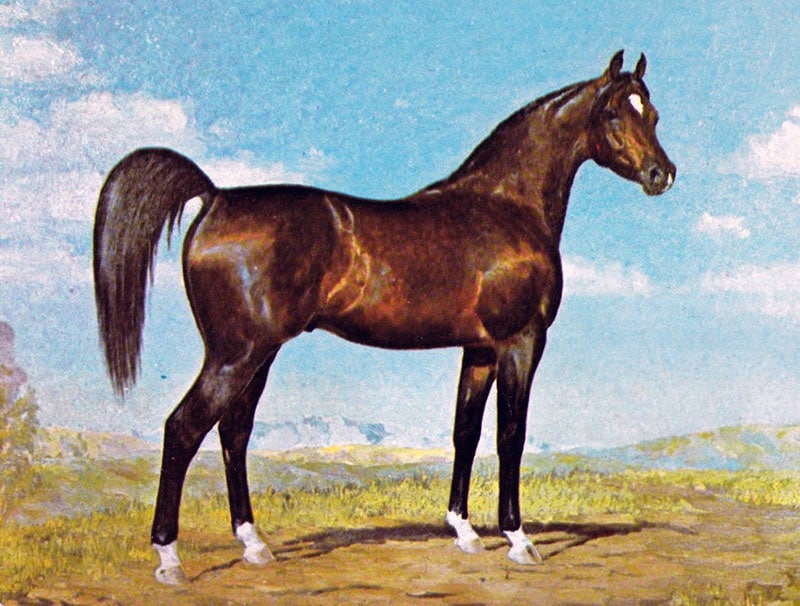
Witez II, the famed Polish Arabian stallion, left an indelible mark on the world of Arabian horse breeding and garnered international acclaim for his exceptional beauty, conformation, and athletic prowess. Born in 1938 at the Antoniny Stud in Poland, Witez II descended from a long line of esteemed Arabian horses known for their grace and endurance. His sire was the legendary Skowronek, and his dam, Ofirka, contributed to his impressive bloodline.

Witez II's reputation as a superior breeding stallion was solidified during his time at the Janów Podlaski State Stud, where he became an influential sire. His descendants went on to make significant contributions to Arabian horse breeding programs worldwide, enhancing the breed's quality and preserving its unique characteristics. Witez II's offspring were not only successful in the show ring but also excelled in diverse equestrian disciplines, showcasing the versatility that the Arabian breed is known for.

Beyond his influential role as a sire, Witez II achieved recognition for his own show career. Renowned for his stunning presence, he captured the attention of enthusiasts on both sides of the Atlantic. His accolades include championships at prestigious shows, such as the Salon du Cheval in Paris and the National Arabian Horse Show in the United States. Witez II's impact was not limited to the realm of horse shows; he became a symbol of the enduring beauty and grace associated with the Arabian horse.

Witez II's story is intertwined with the broader narrative of Polish Arabian horse breeding, which has consistently produced horses of exceptional quality and distinction. His legacy endures through his descendants, who continue to impress in various equestrian endeavors, carrying forward the tradition of excellence that Witez II epitomized. Today, the Polish Arabian horse community and enthusiasts worldwide celebrate Witez II as an iconic stallion whose contributions have left an enduring imprint on the history and heritage of Arabian horse breeding.


Get your own copy of "The Stallion and His Peculiar Boy" wherever books are sold. Autographed copies are available from the website: www.dancinghorsepress.com


Thursday, October 12, 2023

"FINDING FIONN" 

IS A NEW RELEASE COMING OCTOBER 17TH INSPIRED BY THE KIDNAPPING OF THE FAMOUS IRISH RACEHORSE SHERGAR!


On a cold, foggy night in county Kildare, Ireland, the famous racehorse, and Irish hero, Shergar was kidnapped. The next day, a phone call came in to his trainer with a demand for 2 million pounds. Shergar's owner refused to pay and the horse was never seen again. To this day, this mystery has not been solved. 

Shergar was the 1981 European horse of the year. He shocked everyone by winning the Epsom Derby in England by more than 10 lengths. 

Shergar was beloved by everyone who knew him and worked with him. After an extremely successful career as a three-year-old. He was retired back to his birthplace, the Ballymany stud in Ireland. As a four-year-old, he fathered many successful colts and fillies. But his promising career as a stud came to a halt on that fateful night in February 1983. 
Many theories abound as to who was responsible for his theft. Was it the Irish Republican Army (IRA) seeking funds to continue their war efforts? Was it a jealous competitor? Was it insurance fraud? 

No one knows. 

My new book, to be released on all sites on Oct. 17, 2023, takes the facts of the kidnapping and applies them to a fictional horse named Fionn MacCool. Because I am an author, I can create the ending to the story as I would like to have seen it happen. 

Autographed copies are available on the website: www.dancinghorsepress.com


Tuesday, November 29, 2022

THE STALLION AND HIS PECULIAR BOY


My new book "The Stallion and His Peculiar Boy" will be out in the spring! It is a Historical Fiction based on the life of the famous Arabian Stallion, Witez II. The professional reviews of starting to come in. Here is one from Readers' Favorite:

Review Rating:

5 Stars - Congratulations on your 5-star review! 


Reviewed by Kimberlee J Benart for Readers’ Favorite

The Stallion and His Peculiar Boy: Based On the Life of the Famous Arabian Horse Witez II

is a work of historical fiction by M.J. Evans set in the period 1943 - 1965. Teodor is a 

non-communicative autistic boy living in Hostau, Czechoslovakia, where the finest 

captured horses from all over Europe are sent to a Nazi breeding farm. Teodor meets 

Witez, the two bond immediately, and he becomes a worker at the farm where he trains as 

Witez’s groom. Later, as the war ends and the horses come under the threat of being 

slaughtered for food by the advancing Russian Army, some German officers ask the United 

States Army to rescue the animals and take them out of Czechoslovakia. Soon, Teodor 

accompanies Witez to America in the adventure of a lifetime.


In The Stallion and His Peculiar Boy, M.J. Evans gives us an entertaining and informative 

account of the Polish horse who became a premier stallion in the pedigree of the Arabian 

breed in the United States. Told in part through the fictional character of Teodor and 

sensitive to his therapeutic and devoted bond with Witez over the years, it blends the 

suspense of a World War II military rescue operation with the subsequent challenges of 

resettlement in a new land with new owners. The narrative is engaging and moves at a 

good pace. The choice of an autistic protagonist adds a special dimension, and Teodor 

is both relatable and believable. Suitable for young adult and adult readers, this story 

is sure to please anyone who enjoys good historical fiction.

Tuesday, September 20, 2022

Belgium's 500 Year Tradition of Shrimp Fishing on Horseback


Since the late 15th century, fishermen in the seaside communities that line the North Sea have practiced a unique form of shrimp fishing. While riding a horse, these fishermen, called "Paardenvisser," trawl the shallow waters along the coast to capture the well-loved crustaceans. 


They came up with a very ingenious method of fishing. Riding a Brabant Draft Horse, they pull a net attached to two metal and wood boards. The water pressure keeps the net open as well as pushes the catch to the back of the net. A metal chain attached to the front of the net sends shockwaves through the sand which causes the shrimp to jump into the trap. I have no idea who the brilliant person was who thought of that!

The paardenvissers can be seen wearing their bright yellow oilskin pants and jackets atop their sturdy horses during shrimp fishing season which lasts from March to May and September to November. There is a two-day Shrimp Festival in June when the horses get to parade down the streets leading elaborate floats. 

At this writing, there are only seventeen known paardenvissers. 

So that is your fun horse fact for the day!

COMING SOON: MY NEW BOOK ABOUT THE FAMOUS POLISH ARABIAN STALLION, WITEZ II! More info on that next time.

Monday, September 27, 2021

THE SAND POUNDERS OF THE U.S. COAST GUARD DURING WWII

 It's not your fault if you have never heard of the Sand Pounders...most people haven't! 


For two years during World War 2, the U.S. Coast Guard had a mounted beach patrol. After the U.S. was attacked by Japan on December 7th, 1941 at Pearl Harbor in Hawaii, the call went out to Horsemen across the country to enlist in the new division of the Coast Guard called the Sand Pounders. Their job was threefold: 

“We have been tasked with protecting American shores against sabotage, enemy submarines, and enemy landings. We have three basic functions: to detect and observe enemy vessels operating in coastal waters and to transmit information thus obtained to the appropriate Navy and Army commands, to report attempts of landing by the enemy and to assist in preventing such activity, and to prevent communication between persons on shore and the enemy at sea.” (The Sand Pounder pg. 66)

Cowboys, jockeys, show jumpers, horse trainers, and rodeo riders answered the call. In all, 24,000 men signed up to patrol 3700 miles of coastline on the east coast, the west coast, and along the Gulf coast. 

I was born in 1951, just a few years after WWII ended. My family lived in Oregon and we often went to the Oregon Coast. My father took us to Fort Stevens, the only place in the continental U.S. that was shelled during the war. He talked to us about the war but he never mentioned the Sand Pounders!

It was just a few years ago that I stumbled upon them. I began researching. I was able to get a copy of the newly released confidential report that the Coast Guard had submitted so many years before. I researched for a year. (Which is why I haven't written a blog post for so long!)

Thus...my new novel was born! 

"The Sand Pounder - Love and Drama on Horseback in WWII" is a young adult to adult historical fiction. Set on the Oregon coast, it is the story of an older teen who wants to become a sand pounder. The only problem is, SHE is a girl and they are only taking men. Let's just say it is a "Mulan" story- if you know what I mean! I mixed in a lot of horse stuff, a little romance, and information about both the Sand Pounders and what life was like for citizens during world war 2. 

I am honored to receive the Maincrest Media Award for outstanding Historical Fiction before the book was even released. The release date is September 28th, 2021. 
Here is what the critics are saying: 
“Evans’ writing and use of descriptive imagery is incredible.” Maincrest Media Awards

 “The Sand Pounder is one of those rare historical novels with a charm that appeals to both young and old readers.” Vincent Dublado for Readers’ Favorite

 “M.J. Evans does an excellent job of winding the era's history and the lesser-known job of the Sand Pounders into a realistic story of a mature teen's determination to make a difference in her world.” Diane Donovan for Midwest Book Review:

 “A gripping YA historical novel packed full of twists, turns, and memorable characters. Highly recommended!”  The Wishing Shelf Book Review(UK)


This fun and informative book is available NOW on my website: 
and wherever books are sold. 

Tuesday, December 22, 2020


Please enjoy this author interview by "AllAuthor"


Q.What is one lesser-known fact about your childhood?
I bought my own horse when I was 13 and had to support him myself. I babysat, cleaned houses, and walked polo ponies between chukkas (the play period.) I loved that horse, and I was so busy taking care of him, I never had time to get in trouble!

Q. Who is the most supportive person in your life when it comes to your writing?
My grandkids!!! They always tell me how much they love my books. That keeps me going.

Q. How would you describe your experience as a former teacher?
I loved teaching teens and pre-teens. I enjoyed the depth I could get into with my high school students, but I loved the energy of the younger teens in Junior High. I also learned that a good teacher is kind of like being on stage and entertaining an audience.!

Q. Why do you mostly write about horses or horse-fantasy creatures?
I have been a horse-lover since birth...I call it "being born with manure in my blood!" I started taking riding lessons when I was eight. When I wasn't on a horse, I war reading both fiction and non-fiction books about them. Thus, I developed a love of reading as well. Fantasy has always been a favorite genre of mine so combining fantasy and horses seemed like the perfect fit. have expanded my horse stories to include "coming of age," and "historical fiction" to challenge myself.

Q. What developed your love for horses?
As I mentioned, I was born loving horses. Owning my own horse and sacrificing to take care of him served only to deepen my love. Your love increases as you serve and sacrifice.

Q. What inspired your first original story? Did you share the tale with anyone?
My first book was a non-fiction book titled: "Riding Colorado." it is an equestrian trail guide book and is the first of a now, four-bok series about trails to ride in and around colorado. I researched and wrote those books for the selfish reason that I wanted to find all the cool trails to ride. I had five other horse friends testing the trails with me, so, yes, I shared the experience with them. 


As we would drive to the trailheads, I would tell them the fiction story I was creating that became "Behind the Mist-Book One of the Mist Trilogy."


Q. What is the significance of the title of your book, "In the Heart of a Mustang?
For several years, I worked for PATH, Intl,., The Professional Association of Therapeutic Horsemanship. There I witnessed the healing power of horses not only for disabled and handicapped people, (I write about that in "PERCY-The Racehorse Who Didn't Like to Run,") but I was also touched by the effect horses have on troubled teens. I coupled that with my  interest in the bands of wild mustangs running free in ten western states and came up with "In the Heart of a Mustang." People who have adopted these wonderful horses love them so much.


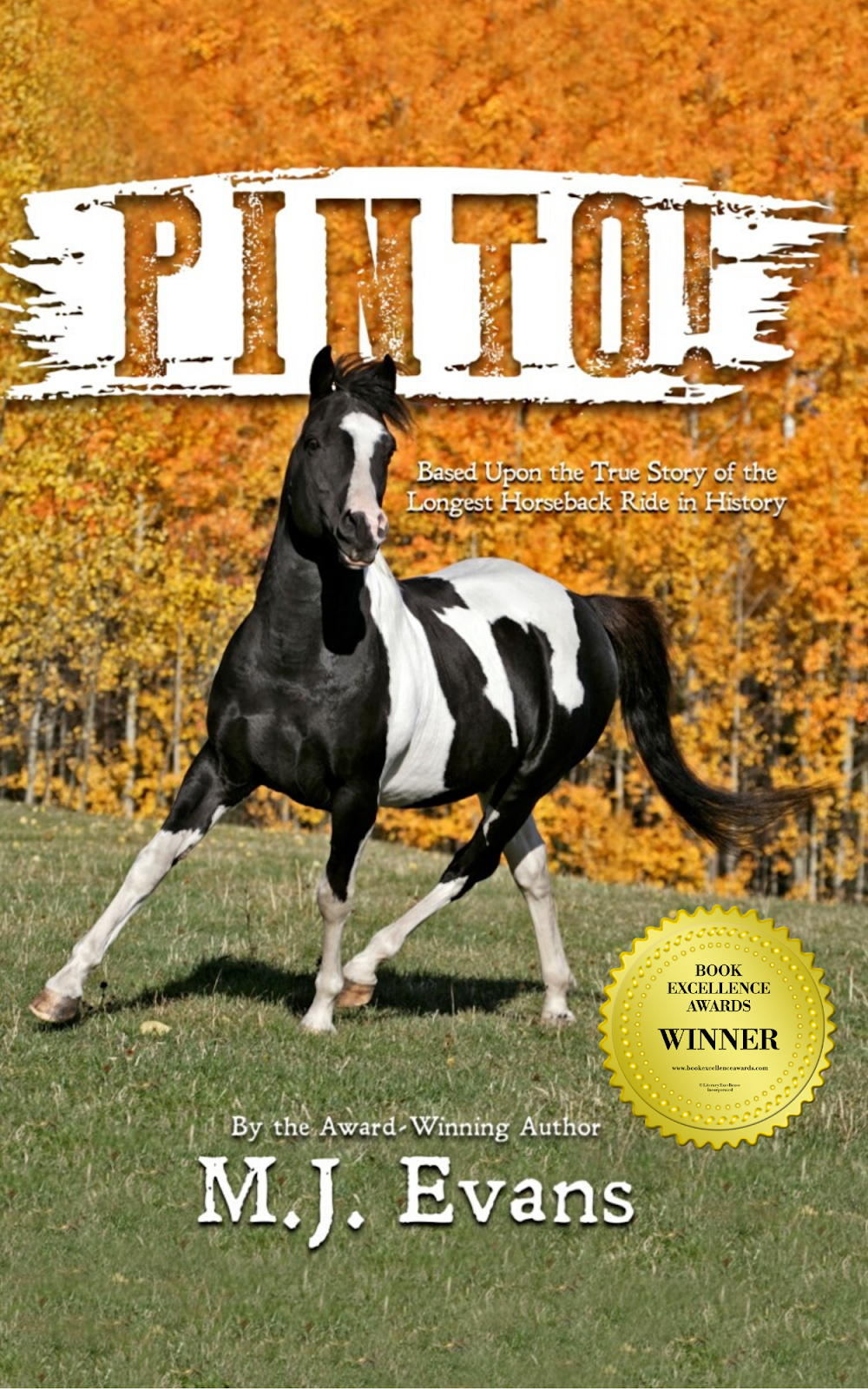
Q. How much did you research about the longest Horseback ride in history while writing your book, "PINTO!"?
"PINTO!" took me two and a half years to research and many miles of travel. I started doing research on the internet. I found a little...just enough to pique my curiosity. I traveled to Oklahoma City to visit the National Western and Cowboy Museum. the research librarian didn't even know they had a collection of material. But, after searching in their basement, they found a box of original photographs and a few articles from the time. I went up to Bainbridge Island, Washinton to their little historical museum and was greeted like royalty. They were so excited that I was going to write about their hometown heroes. They have a permanent exhibit of the Overland Westerners and a driftwood sculpture of Pinto. In their collection are all the original journals still in existence that two of the men kept. I was able to take home a flash drive with the transcriptions of the journals. I read every word and highlight the events that Pinto could tell about. It was so much fun!


Wednesday, January 9, 2019

Two New Releases in December


I have been very busy the last few months getting two new books ready for publication. It actually takes a lot of work finalizing covers, getting professional reviews, setting up distribution, and on and on. And now it is done! YAY!

"The Stone of Wisdom" is the fourth and final book of "The Centaur Chronicles." This series, about a land filled with Centaurs, Ogres, Cyclops, and a tiny race called the Duende, has won numerous national and international literary awards. That is great when the critics like my work, but it is even greater when my middle-grade and YA readers love it! It is so fun getting emails from them. It makes all the hard work worth it when they write to me to say they love the books.

"PERCY - The Racehorse Who Didn't Like to Run" is my first-ever picture book for 3 to 7 year-olds. The Industry Standard for a picture book is 30 pages and 1,000 words. That is hard for a novelist like me that usually writes about 65,000 words! But I had fun working on it and working with an illustrator. I had strong opinions about what I wanted the illustrations to look like. I don't like picture books where the horses have big buck teeth and oversized hooves. I want the horses to be beautiful. This story is about a little, thoroughbred colt who was supposed to grow up to become a great racehorse. However, he doesn't like to run! The wise, old mare in the pasture advises him to find his true purpose. This he does as he becomes a therapy horse and becomes the feet for disabled children. I am excited for little children to get to enjoy this book.

All of my books are available on my website:
www.dancinghorsepress.com

Or here are the links to Amazon:
The Stone of Wisdom: https://www.amazon.com/Stone-Wisdom-Centaur-Chronicles/dp/1948543575/ref=sr_1_1?ie=UTF8&qid=1547052701&sr=8-1&keywords=The+Stone+of+wisdom

PERCY-The Racehorse Who Didn't Like to Run https://www.amazon.com/Percy-Racehorse-Who-Didnt-Like-dp-0996661778/dp/0996661778/ref=mt_hardcover?_encoding=UTF8&me=&qid=1547052771

Friday, July 6, 2018

YETTI IS IN CELESTIA EARNING HIS UNICORN HORN

I am grateful that "The Mist Trilogy" brings comfort to those who are grieving the loss of their beloved horse. I received this letter and photo from the head instructor at Promise Ranch in Franktown, Colorado. It is a PATH, Intl certified therapeutic riding center. They are mourning the loss of Yetti, who passed away this week at only 20 years of age.


 This picture is so precious. The young man in the photo is a former rider at Promise Ranch, Patrick, who passed almost 2 years ago. It gives me great peace to know that Yetti and Patrick are together again. I have a dear friend, Margi Evans, who wrote a trilogy of books: "Behind the Mist," "Mists of Darkness," and "The Rising Mist," in which the young rider and his horse pass and learn that horses pass to become unicorns and continue to live and are protectors of animals and humans in our world. I know that Yetti truly earned his Unicorn Horn and gallops in Celestia among the great and noble horses!
-Carol Crisp-

Thursday, March 22, 2018

GRIEVING THE LOSS OF YOUR HORSE

It has been six weeks since I lost my beautiful Jazz and I can't stop hurting. I cry at the mere thought of him. If anyone asks me about him, or worse yet, when those that don't know ask if I am getting ready for show season, I start crying. Then I find myself apologizing because I know this makes them feel uncomfortable. At public speaking engagements, I am asked how many horses I have and I say "Three...um, two." Then I feel the tears stinging the backs of my eyes again!

I realized that some of you may have gone through or are going through the same grieving process that I am. I have been reading articles about grieving the loss of a pet and have learned that it is just the same as grieving the loss of a human family member. (We all know that our horses are part of our family, especially if we have had them for a long time. I had Jazz for 12 and 1/2 wonderful years!) I am going through the same stages of grieving that is normal for anyone. I even got mad at God for a while. "Why would you take Jazz from me?" I cried aloud. I am trying to develop more gratitude for the 12 and 1/2 years He let me have such an amazing horse and realize that there are very few people in the entire world who ever get to ride a horse like that!

This is what I learned:
1. ALLOW YOURSELF TO GRIEVE. How you grieve is very personal and each person reacts differently. Let the tears come when they need to and, unlike me, you don't need to apologize. Don't rush it. There is no time limit on grieving...no time at which you "should be over it!"

2. TAKE TIME TO REFLECT ON THE LIFE YOU SHARED WITH YOUR HORSE. You may just need to find a quiet place to think, or look through pictures, or handle those beautiful ribbons or that soft, leather bridle, or stand in the middle of his stall and just breathe. Maybe, like me, you need to write about your horse or talk to friends, especially those who also knew him and the two of you together. Several of my horse friends took me out to lunch to just talk about Jazz. Yes, I cried right there in the restaurant, but I laughed, too.

3. TAKE CARE OF YOURSELF AS YOU GRIEVE. As silly as it sounds, grieving is taxing on the body. Eat nutritious meals...don't bing on junk food! And get both exercise...very important...and sleep.

4. MAINTAIN ROUTINES WITH YOUR LIVING ANIMALS. I still have two wonderful horses that need my love and care as well as a bouncy new standard poodle puppy that needs to be played with. It first I didn't think I could face Jazz's empty stall by going into the stable. But Hardy and Kit needed me, so I went. It was awful but I did it. Kit and Hardy knew something was wrong and they seemed almost depressed. I gave them lots of treats and rubs. The puppy, well, she's a puppy...she just wants to play and that makes me laugh.

5. MEMORIALIZE THE MEMORY AND LOVE OF YOUR HORSE. I believe that animals have souls and inherit eternal life just as we do. While it brings me great comfort to know that I will be with Jazz again, I needed something tangible here and now. The vet sent me a braid of his tail hair intertwined with red ribbon and I had a picture of him blown up and framed. Yes...as you might guess, both make me cry but remember, that's okay.

6. SEEK SUPPORT FROM UNDERSTANDING FRIENDS AND RELATIVES.  I have been blessed with a wonderful husband, children, and friends, both horsey and non-horsey. Fortunately, my husband, Tom, was in town when the vet called to tell me to come say goodbye. He took we and hugged me as I hugged Jazz. A few days after Jazz's passing, I told Tom that I was blaming him because if he hadn't bought that wonderful horse for me, I wouldn't be hurting so much now. He just nodded and said, "I'll take the blame." I also received flowers, cards, candy, cakes and even a "heart attack" (where your house is decorated with cut out hearts and love notes.) I didn't handle some offers of kindness very well. When friends would ask, "What can I do?" all I could say was "Bring Jazz back." Frankly, that was my true feeling.

I hope this will help someone out there in internet land. I adapted this list from an article titled "7 Self-Care Essentials While Grieving the Death of a Pet" by Adam Clark LCSW< AASW

Tuesday, November 7, 2017

TRAIL GUIDE THE OLYMPIAN

Some horses get to enjoy a variety of careers in their lifetimes. Such was the case with Trail Guide. He went from a cavalry horse to a big-(and mean REALLLLLY big)time show jumper.


Trail Guide was a two-time Olympic Showjumper. The beautiful thoroughbred was out of Trailoka, a mare who was also an Olympic mount, competing in 3-day eventing.

The famous rider, Hugh Wiley rode Trail guide to an 11th place finish in the 1956 Olympics. When he turned 21, Trail Guide led the US Olympic team to a team Silver Medal while being ridden by Show Jumping legend, Frank Chapot during the 1960 Olympic Games in Rome Italy.

Trail Guide won numerous championships at the top shows. He was ridden by the best riders: Hugh Wiley, Frank Chapot and Bill Steinkraus.
Trail Guide's life ended, shockingly, in 1960 in the show ring of the National Horse Show. He crashed into a five-foot fence and broke two vertebrae in his neck. A curtain was pulled around him and he was euthanized right there in the arena, surrounded by the jumps that he loved and the people who loved him.

Trail Guide was inducted into the Show Jumping Hall of Fame in 1995.
Show Jumping Hall of Fame


Christmas is coming and you and your horse-loving friends and family will love my new fantasy series: The Centaur Chronicles.  The first two of the four books are available now.
This AWARD-WINNING Series is receiving both fabulous critical reviews and national and international awards for middle-grade and young adult fantasy. Please visit my website and order an autographed copy for a Christmas or Holiday Gift.

Click Here: www.dancinghorsepress.com

Also available wherever books are sold.

Wednesday, September 20, 2017

NUMEROUS AWARDS

I am so excited to tell you that I have received numerous Literary Awards in the last month.
The first book of my new series, "The Stone of Mercy-Book 1 of the Centaur Chronicles," received the Silver Medal from the Literary Classics Awards for fiction. I attended their award ceremony on the 3rd of September in Rapid City, SD.
When I returned from my trip, I was informed that "In the Heart of a Mustang" won the Silver Medal from the Readers' Favorite International Book Awards! Their award ceremony is in November in Miami. However, I will not be able to attend as I will be at the Equus Film Festival in New York City that same week.

If you love to read horse stories or stories about Horse-Fantasy creatures, you can get these books on my website:
They are also available on Amazon and Barnes & Noble. 
If your local library doesn't have them, please put in a request. 
www.dancinghorsepress.com

Tuesday, June 13, 2017

THE STONE OF COURAGE...A SWITCH TO CENTAURS!

I am so grateful to Blaze Magazine for this wonderful review of "The Stone of Courage - Book 2 of the Centaur Chronicles." Blaze Magazine is a great magazine for horse crazy kids. It is available in print or on line. You can check them out here:
http://blazekids.com/


Here is their review:

You can get "The Stone of Courage" as well as "The Stone of Mercy-Book 1 of the Centaur Chroniles" on my website: www.dancinghorsepress.com or on amazon or wherever books are sold. It is also available for Kindle.


Monday, January 16, 2017

TO BLANKET OR NOT TO BLANKET


I live in Colorado and it is that time of year that I spend a lot of time putting on and taking off blankets. You see, Denver's weather is what I call Bi-Polar...bitter cold one day, shirt sleeves the next. This makes it hard for my poor horses's winter coats to know if they are really needed or not.

Horse people are always discussing that eternally significant question: Should I blanket my horse or not? I saw this funny post on facebook from Auburn University:


I thought it was pretty funny! I especially love the question, "Is your horse a wussy?" --Yes!--Your horse probably needs a blanket.

I have read all sorts of articles arguing one way and the other about whether or not to blanket a horse. Those opposed claim that the blanket will compress the natural thick winter coat and thus destroy the natural insulation it provides.

On the other hand, most articles said blankets would probably be best if the temperature is below 10 degrees Fahrenheit or the horse is not able to find shelter, especially from wind. Wind seems to be more of a factor than cold.


Of course, if your horse is old or sick, he would need a blanket.
If he is accustomed to being in a stable, he would need a blanket if suddenly put outdoors.
If he is clipped, obviously he needs a blanket in cold weather.

One result of blanketing is that it prevents the winter coat from getting as long and thick as it might otherwise become. This is good if a horse is being worked a lot in the winter so that he doesn't get over-heated and it becomes hard to cool him off. This is my situation. I take my horse from an unheated stable to a heated arena for my dressage lessons. Even though I blanket him, he gets quite sweaty during our lessons.

Another reason to blanket is to help keep the horse clean. Dust helps insulate the unblanketed horse but that means a lot more grooming to get ready to ride.

After my reading I concluded that when all is said and done, it is up to you! (With the noted exceptions listed above.)


Tuesday, November 15, 2016

THE HISTORY OF THE WILD MUSTANGS

My award-winning coming of age novel titled "In the Heart of a Mustang" was inspired by two things. First, I worked for several years for PATH International, the organization that trains and certifies  riding instructors to be able to work with not only disabled and handicapped people but also with at-risk youth. I heard many stories about the healing power of horses for teens who were struggling with life's challenges. Second, I have always been fascinated by the wild mustangs that run on public lands in the west. So, I decided to research more about them. The result of these two events in my life is the book: "In the Heart of a Mustang."

I want to share with you some of the things I learned researching information about the wild mustangs.


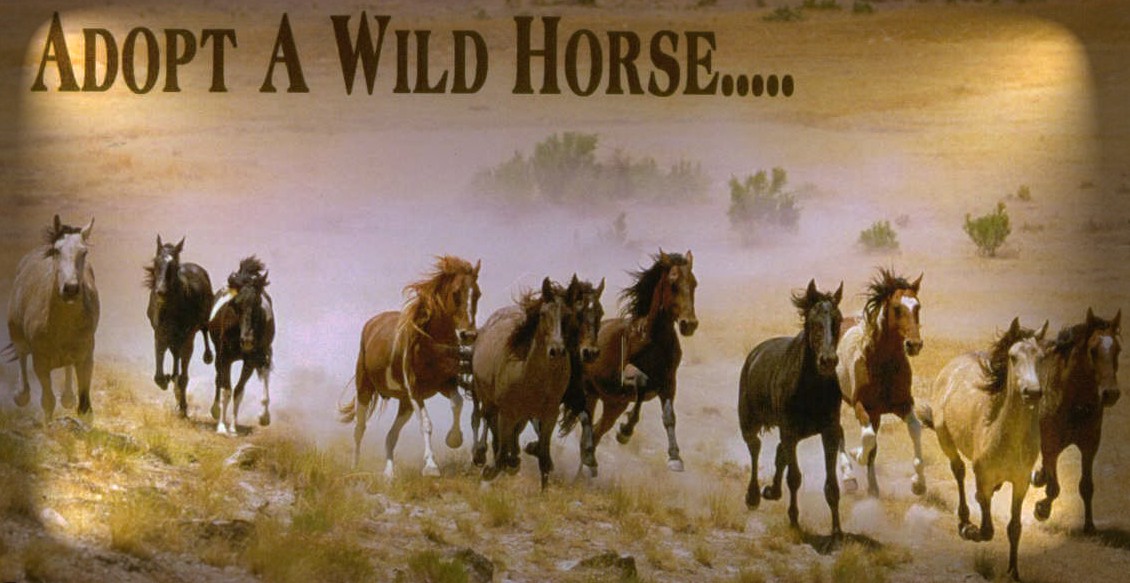
Our modern day Mustangs are descendants of the Spanish or Iberian horses brought to North America in the 1500's. They were first brought to the mainland by Cortez in 1519. Their name comes from the Spanish word "Mustango" which means "ownerless beast" or "stray horse." Over the centuries, these horses have bred with other types of horses including quarter horses and draft horses and others that got lost or were set loose. Based upon DNA testing, the Pryor Mustangs, found in the Pryor mountains of Wyoming and Montana have the purest bloodline back to the Iberian horses.

The Native Americans began using these horses for transportation while hunting, moving and at war with one another. The early pioneers liked them for their stamina and their sturdiness. Since the earliest days of their domestication, mustangs have been cross-bred with other horses including thoroughbreds.

Because mustangs are descendants of escaped domesticated horses, the wildlife management agencies consider them to be "feral" rather than "wild." To protect these historic animals, congress passed the "1971 Wild and Free-roaming Horses and Burros Act." This act gives responsibility for the management, protection and study of "unbranded and unclaimed horses and burros on public lands" to the Bureau of Land Management and the Forest Service. This act has been revised and amended over the years but, basically, it established lands upon which the horses may roam freely and set the "Appropriate Management Level" (AML) for the size of the herds. The AML is set at 26,715.

The act was passed to protect the dwindling herds. Since then, the size of the herds has exploded. A herd (or band) of mustangs can double in size in just four years. Obviously, this results in serious problems. As of March 2015, there were more than 58, 150 on-range horses and burros and another 47,000 being kept at holding facilities hoping for adoption at a cost to the taxpayers of $43 Million per year.

Solutions are not easy to come by. There are conflicting interests for the land. Ranchers want to run sheep and cattle. Energy companies want to drill for gas and oil. Builders want to develop shopping centers and neighborhoods. The Highway division wants to build roads.  In addition, several of the plots of land that have been set aside are not suitable for horses and they can not survive on it. Some plots of land have no water, others not enough forage.

As the herds get too large, what should be done? The law forbids the moving of large herds to land with smaller herds. So it isn't that easy.

Some people simply want nature to take its course...i.e.. Let the horses starve to death to decrease the herd size. I am not in favor of this solution.

Neutering stallions doesn't work for two reasons. First, it only takes one stallion to impregnate the whole herd. Second, it changes herd dynamics. Geldings become social outcasts.

The best two solutions, in my opinion, are using a mare contraceptive called PZP or PZP-22. These injections will work for a year or two respectively.

The other solution is a program started in 1973 called "Adopt-A-Horse." This has had some success and is the program I promote in my book, "In the Heart of a Mustang." Two problems with this, however, and why I think using PZP is necessary, is that, as noted above, there are already thousands of horses waiting for adoption and there simply aren't that many people qualified to adopt and train a wild horse.

There have been some success stories and great programs. The Chincoteague Ponies off the coast of Virginia have been stabilized using a combination of PZP and adoption. I realize it is a much smaller herd and a controlled environment, but it has worked for them.

Several programs have been developed that provide equine therapy for prisoners such as the Canyon City Prison Adoption Program (W.H.I.P) in Colorado and the Arizona Prison system Adoption Program.

But you don't have to be a convict or troubled youth to adopt! One organization that has promoted adoption is the Extreme Mustang Make-overs. They sponsor a contest each year in which trainers can adopt, train over a three month period, and sell, a mustang. For more information on their program go to their website: http://extrememustangmakeover.com/

You can also adopt right from the BLM. Go to this link: https://www.blm.gov/adoptahorse/

If you are interested in reading "In the Heart of a Mustang," a book that will touch your heart, go to the website: www.dancinghorsepress.com 
It is also available on Amazon and for Kindles.

Literary Classics Awards said of this book: "In the Heart of a Mustang is one of the finest books ever written for teens and pre-teens."

Monday, October 31, 2016

HAPPY HALLOWEEN UNICORN STYLE

Happy Halloween from unicorn Jazz!
(Jazz is the star of The Mist Trilogy)

Thursday, August 4, 2016

THE LEGEND OF BABIECA


Perhaps the day of the war horse is gone but their legends live on. This is true of Babieca (there are numerous spellings!) the mount of the famous, or "infamous" depending upon the source, El Cid.

El Cid who lived from approximately 1043 to 1099, was the son of minor nobility in medieval Spain. He was raised in the court of King Ferdinand the Great and was a servant to the king's son. He became a renowned, feared and beloved war hero as he battled for the Spanish cause of expanding their territory. To this day, El Cid, full name Rodrigo Diaz de Vivar, is a Spanish folk hero and national icon. He is the subject of numerous plays, poems, and paintings.


But what of the horse? El Cid's favorite horse was Babieca, a white Andalusian Stallion. No one really knows the history of how they came to be battle partners. One story has it that El Cid was offered his choice of any of the horses in the herd of Andalusians by his godfather, a monk at a Carthusian monastery.  He chose the littlest, weakest one. His godfather thought it was such a poor choice that he exclaimed "Babieca!" which means "Stupid." 

Another story is that El Cid was given the horse by King Sancho when El Cid was challenged by another Knight to become the king's champion. The story goes that Babieca was bred and raised in the royal stables in Seville and was a highly trained and loyal war horse when El Cid got him.

Whatever the truth, El Cid loved the horse and even requested that they be buried together. 

A little side note: Did you know that our modern day discipline of Dressage has its origins in the training of War Horses?


Check out my new website for my books: www.dancinghorsepress.com

Tuesday, May 24, 2016

A STABLE FIT FOR A UNICORN!

I really love my stable. It is so pretty and so big! I have three 16 X 12 foot stalls that each has it's own run. I have a lovely tack room with a bathroom, and a feed room with a washer and dryer for blankets and saddle pads. (My husband is so happy that he doesn't have horse hair on his underwear anymore.) I also have plenty of room for hay storage. Sounds pretty perfect, doesn't it?

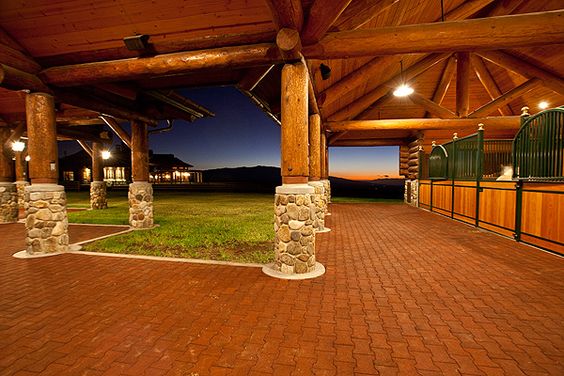
Well...then I found these pictures of stables:


Can you believe these stables? Now I feel like a slacker and a cruel person for making my horses live in a shack!!! I want to know where the dust is? Where are the flies? Where are the manure stains? Where is the scapped off paint and chewed wood?  

Oh well. My horses may not live in a palace like one of the ones above but they are so happy and spoiled that if I leave a gate open, they won't run away! I think I will add some potted plants out front, however!