This Blog is dedicated to the Noble and Great horses in our lives and throughout history. Visit the land of the unicorns in Behind The Mist, the horse lover's fantasy for pre-teens to adults.


Order here now:


http://behindthemist.com/

Wednesday, January 30, 2013

SHETLAND PONIES-The littlest unicorns!

How many of you grew up dreaming of owning a pony? Probably all of you. My image of the ideal childhood was riding around the back yard on a cute little pony just like Carolyn Kennedy was doing on the white house lawn on her pony "Macaroni." I kept trying to talk my dad into letting me keep a pony in the back yard. After all, they don't take up very much room, and then we wouldn't have to mow the lawn! He never bought into my plan any more than he went with our idea to hand dig a swimming pool! I also remember that, as a kid, I could fall off and actually bounce right back up. That doesn't happen anymore. First of all, my  horses are much bigger and second, my body doesn't work like that anymore. Sighhhhhhhhh.

Today, I want to write about Shetland Ponies. The ones I knew were both tiny and feisty. So, that is my impression of the breed. I want to give you a little background.


Shetland ponies of today are descendants of the ponies that roamed the stormy islands of Shetland off the coast of Scotland.  They were built tough to withstand the harsh elements. The islands are cold and wet. So, the ponies have short legs, thick necks, long manes and heavy coats, all designed to conserve body heat. Grazing was tough most of the year so they would actually roam the beaches in search of seaweed and fish heads to eat. They were also forced to drink salt water. 

Originally, these ponies were seldom ridden. They were our tiniest work horses. Pound for pound, they can pull more weight than a large draft. They can pull twice their own weight which even Shires or Clydesdales (see my blog from Jan. 9, 2013) can not do. The ponies were used to carry packs across rough terrain, pull heavy carts on farms and work in Britain's mines. These smart little ponies actually saved many a miner's life.  

Today these ponies are used as pets. They are measured in inches, not "hands" as horses and larger ponies are. They are usually up to 42 inches high at the withers (where the shoulders come together at the base of the neck.) There are now two types of Shetlands, the American Shetland and the British Shetland. Both retain their sturdy look but many have been developed into a more elegant animal. They are used for riding and driving. 

If you love horses, read the first two books of the Mist Trilogy: Behind the Mist and Mists of Darkness (just released on Jan. 15, 2013.) You can order an AUTOGRAPHED copy here AND save a dollar off the retail price!
www.behindthemist.com

They are also available on Amazon, Barnes & Noble and many other sites.

Monday, January 7, 2013

THE BUDWEISER CLYDESDALES


I am not a beer drinker but if I were, I would have to drink Budweiser because I love their corporate symbol...the teams of Clydesdales. They also have the coolest commercials! I love the one above about the "Little Donkey that could!" That is just one of many awesome commercials, some that even make you cry. Behind the Mist readers will remember that Salamite and Portlas, the evil unicorn Hasbadana's guards, were Clydesdales. So, I decided to learn more about the Clydesdales and share it with you. The first team of Budweiser Clydesdales were a gift to celebrate the end of prohibition in 1933. August Anheuser Busch, Sr. was given the gift by his son. Today, the St. Louis MO headquarters of the brewing company are also the headquarters of the teams of horses. The company owns the largest herd of Clydesdales in the world.
 The breeding farm called "Grants Farm" near St. Louis, Missouri, houses approximately 35 mares, stallions and foals, with an average of 15 foals produced each year. This is ranked as one of the top family attractions in the country so add that to your list of places to see! Anheuser-Busch owns a total of about 250 Clydesdales, kept at various locations throughout the United States. There was a second breeding farm located near Romoland, California, about 60 miles southeast of Los Angeles, but I believe that has been moved. There are six "Hitches" (the name for teams)of Clydsdales in different locations around the country. Each Hitch is made up of ten horses. Eight pull the wagon and two are on standby. Only five of these teams travel around the country. One always stays in Missouri. There are strict qualifications to be a horse on one of the hitches (the commerical notwithstanding.) The horse must be a gelding that is at least four years old. It must stand at least 18 hands (a hand is 4 inches) at the withers and weigh 2,000 to 2,300 pounds. He must be bay (brown body with a black mane and tail,) have a white blaze down its face and have four white socks (coloring below the knee and  hock) with white feathering (long white hair that covers the hoof.)

These fabulously trained horses are used in parades, including an annual appearance in the Rose Parade, and other promotional events. They are transported around the country in huge semi trucks with all the luxuries available, including video cameras so that the drivers can keep an eye on them. 

Read about the Clydesdale unicorns Portlas and Salamite in Behind the Mist and the just released Mists of Darkness. Click here:
www.behindthemist.com to get a special discount price of just $9.95!

Send me the story of your noble and great horse. Write to me at: mjevansbtm@gmail.com. Include a picture if possible

Thursday, December 20, 2012

THE TWELVE DAYS OF CHRISTMAS FOR HORSE LOVERS!

Merry Christmas dear readers! I hope you get a kick out of this. I love horsepeople. They are so good at laughing at themselves! I wish I knew the source for this. It was sent to me by a reader. Merry Christmas and Happy New Year! Thanks for reading my blog!
Try to squeeze just $9.95 out of that bank account and order Behind the Mist or Mists of Darkness from the website! Special price now! Go to: www.behindthemist.com

Thursday, December 13, 2012

WATCH OUT FOR COLIC IN YOUR FUTURE UNICORN

Those of us who are fortunate enough to own a horse (or two or three...) love them very much and want to keep them healthy and happy for as long as possible. When Heavenly Father designed horses he made them very beautiful on the outside but he gave them a very fragile digestive system on the inside. It was designed for horses in the wild who are constantly grazing and moving around. Thus, their stomachs always had a small amount of a large variety of grasses and weeds in their stomach and they were walking around from patch to clump, thus helping with the digestion.

Now, don't get me wrong, I believe that horses were designed to be domestic and serve man. Indeed, domestic horses live longer than horses in the wild and for a variety of reasons: better diet, better  hoof care, protection from predators, and so on. But we do, inadvertently to be sure, create problems for our horses through the life we ask them to live. One of the biggest and most life-threatening problems that you need to be informed about if you are a horse owner is Colic.

What is Colic? 
At its most basic, its a tummy ache! It is a general term used to describe any sort of abdominal pain. It can be so mild that you don't even know it is happening or so severe that it becomes a medical emergency. In fact, colic causes more deaths in horses than any other disease! And, surgery for colic is very expensive! (I  know, you are thinking: "What does a rich author need to worry about expenses for?" Well, I am here to tell you that "Rich Author" is an oxymoron unless your name is Stephen King or J.K. Rowling!)

So, What can you do?
First, you can know of and limit the risk factors that can lead to an onset of colic.
1)  Horses are animals (much like children) who do best on a predictable routine. They tend to start worrying if there are any changes. As a result, any change of that routine can actually bring on colic. This would include especially: increased stall time do to an injury or weather; increasing or decreasing the work/exercise load; change in feed whether hay or grain.

Any changes need to be made gradually. If the horse is injured, hopefully you could at least do some hand walking. New feed needs to be introduced by mixing it a little at a time with the old feed. The same is true with exercise. Do not try a steep Colorado Mountain trail your first ride out in the spring for instance.

2) Dehydration. Horses need to have constant access to water to avoid GI trouble caused by impaction. (Food kind of balling up and getting jammed.) If it is freezing outside, make sure you clear water tanks of ice.
Horses drink a lot of water so be prepared!

3) Sand colic is another risk. If your soil is quite sandy it is very possible that the horse could ingest it. This can build up in the GI tract and cause loose stool and other upset. Some vets recommend a daily supplement that prevents this.

4) Parasites can cause intestinal inflammation which can lead to colic. Make sure you keep up on your worming schedule.

Now, even if you are very careful about all of these risk factors, even the best horseman/woman will experience a horse getting colic. The key to recovery is a quick diagnosis. Know the signs that your horse is uncomfortable or, worse, in trouble.

According to SmartPak.com the tell-tale signs are:
Pawing
Looking at, kicking or biting the abdomen
Repeatedly lying down and getting up
Sitting in a dog-like position or lying on the back
Lip curling
Lack of Bowel movements
Reduced or absent gut sounds
Not eating or drinking
Stretching out as if to urinate
Elevated respiratory rate
Elevated heart rat

If your horse displays any of these signs call the vet and follow whatever he/she tells you to do! Let's help our noble and great horses live a long life!

Find out what happens to the noble and great horses after they die. Read the Mist Trilogy, the first two books are now out and ready to purchase in print or ebook format. 
Order now from:
or wherever fine books are sold.

Monday, November 26, 2012

LORD LUDGER AND REBECCA HART...FUTURE UNICORN AND UNICORN RIDER!

I have spent most of the last seven months working for the Professional Association of Therapeutic Horsemanship, International (PATH.) This wonderful non-profit organization works to train and certify instructors and riding clinics that help people with all sorts of disabilities through Equestrian Therapy. Disabilities served include MS, MD, CP, vision and hearing, autism and even wounded wariors. As Ann Romney says in this television interview, Horses are truly a gift from God. They serve and help the able bodied as well as those who are struggling whether physically or emotionally. 
Here is the video from the interview in Times Square with Ann Romney and Para-olympian Rebecca Hart. I am amazed that Lord Ludger is so calm in such a crazy environment! (Sorry about the ads but I don't know how to get rid of them!)

http://gma.yahoo.com/video/parenting-26594265/wheelchair-bound-boy-scores-touchdown-31130203.html
 
I also found this article by Landsay Ysay McCall in the United States Para-Equestrian Association's newsletter that I am sure you will enjoy!
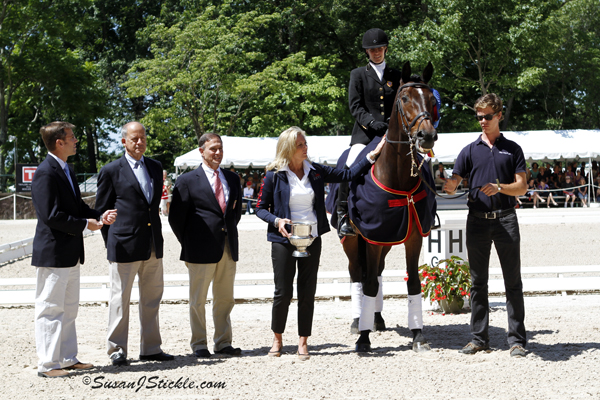
Ann Romney Awards Rebecca Hart and Lord Ludger 2012 USEF Para-Equestrian Dressage National Championship Trophy at USEF Dressage Festival of Champions
By: Lindsay Yosay McCall
Gladstone, NJ –June 26, 2012 – After earning the 2012 USEF Para-Equestrian Dressage National Championship title on June 13, 2012, Rebecca Hart, 26, of Unionville, PA, and Lord Ludger, owned by Jessica Ransehousen, were invited back to the United States Equestrian Team Foundation’s headquarters at Hamilton Farm.  In front of a congregation of press, spectators, and top Olympic Dressage athletes, Hart was awarded the perpetual Para-Equestrian Dressage National Championship trophy from presenter Ann Romney.  Romney has been a long supporter of Dressage, as an owner and athlete and she is a spokesperson for Multiple Sclerosis, which is one of the many diagnoses that specific Para-Equestrian athletes face.
Photo Credit: Rebecca Hart receiving 2012 USEF Para-Equestrian Dressage National Championship award from Ann Romney during the 2012 USEF Dressage Festival of Champions. Photograph taken in Gladstone, NJ (c) Susan Stickle at SusanStickle.com.
In the moment that Rebecca Hart was awarded the 2012 USEF Para-Equestrian Dressage National championship trophy, she felt honored and humbled to represent the sport she has advocated for since 1998. Hart will add this National Championship to a list of accomplishments that she has achieved since 2003. In 2003 and 2007 she represented the U.S. at the Para-Equestrian World Championships, in 2006, 2008, 2009, and 2010 she won the USEF Para-Equestrian Dressage National Championship and earned the reserve championship in 2010. In 2008 she represented the U.S. at the Beijing Paralympics, and in 2010 she represented the U.S. again at the Alltech FEI World Equestrian Games.
Hart expressed, “I have been asked how it feels to have won the National Championship five times.  My answer is that it feels great, but I didn’t win this alone.  It takes a village to compete on this level and this win belongs to everyone who has ever helped me to get this point; From the person who offered the smallest word of encouragement, to family, friends, coaches, and corporate sponsors. I was truly honored to be asked to come back for the awards ceremony and presentation at the able-bodied USEF Grand Prix National Championships and selection trials with Ann Romney.  It is fabulous for Dressage to be brought into the limelight and in conjunction, Para-Equestrian Dressage.  Gladstone is steeped in history and to have my sport included in that history is truly special.  Mrs. Romney was so gracious as a presenter.  It was inspiring to have Mrs. Romney present this award because not only is she herself a fellow equestrian, but she also knows what it means to work with physical challenges.”
In 1998, Ann Romney was diagnosed with Multiple Sclerosis.  As an alternative to her mainstream treatments she began participating in Dressage. As with many equestrians, she jumped head first into the equestrian sport and never looked back. In 2005 she earned her USDF Silver Medal and in 2006 her Gold Medal. While working with trainers Jan and Amy Ebeling she developed a desire to achieve the top of the sport.  In 2012 at the USEF Dressage Festival of Champions her horse Rafalca, co-owned by Amy Ebeling and Beth Meyers, earned the third position with rider Jan Ebeling on the 2012 USEF nominated entries for the United States Olympic Dressage Team.
As Para-Equestrian Dressage and able-bodied Dressage intertwined at historic USET Foundation headquarters in Gladstone, NJ property, spectators began to learn more about the sport of Para-Dressage. Rebecca Hart trains week in and week out while she maintains a full-time job in corporate at the Starbucks Coffee Company.  She trains with Para-Dressage Chef d’Equipe and prominent Event rider Missy Ransehousen, alongside Olympian Jessica Ransehousen at Blue Hill Farm. Hart was born with Familial Spastic Paraplegia, a genetic disease that causes muscle wasting and lack of control from the waist down. Her ability to overcome obstacles has transformed her into an award winning international athlete in both Para-Dressage and able-bodied competition. In the future Hart hopes to reach the top of the Dressage discipline. On June 19, 2012 Rebecca Hart was named to the top of USEF Nominated Entry for U.S. Para-Equestrian Dressage Team for the 2012 Paralympics.
Read about the Noble and Great Horses in the fantasy Trilogy: The Mist Trilogy. 
Order your own AUTOGRAPHED copy of Behind the Mist and the soon-to-be-released Mists of Darkness here: www.behindthemist.com 
Also available wherever books are sold!

Thursday, November 1, 2012

MAN O' WAR - Greatest Horse of the 20th Century


I only know of one horse for whom a heavy metal band was named! Actually, I don't listen to heavy metal bands but I thought it was fun to make the connection with one of the most famous horses of all time. The second scene in Mists of Darkness-Book Two of the Mist Trilogy takes place at Churchill Downs when the evil unicorn Hasbadana sends his oppressive mist to the famous race track to "invite" horses to join his army. So, in honor of Mists of Darkness's impending release, I decided to do another blog post about a famous race horse...clearly one of the noble and great horses that is surely a unicorn now.

Man o' War was born in Lexington, Kentucky on March 29th, 1917. His owner and breeder was August Belmont, Jr. (1851-1924.) The Belmont Stakes had been named after his father. At the age of 65, August Belmont, Jr. joined the U.S. Army to fight in France during World War I. The foal was born while he was away and Mrs. Belmont named it Man o' War in honor of her husband's brave service for his country.

Upon returning from the war, August decided that he was done with the horse racing business and Man o' War was sold at the Saratoga Yearling Auction in 1918 for $5,000. The buyer was Samuel Riddle. The beautiful yearling proved to be a very wise purchase. With Jockey Johnny Loftus riding, Man o' War won 9 our of 10 races as a two-year-old. In those days, there were no starting gates. All of the  horses circled around behind a piece of webbing that was stretched across the track. When the "barrier" as it was called was lifted, the horses started running. In his one loss, it has been reported that Loftus had Man o' War facing the wrong direction when the barrier was lifted and the rest of the field got a big head start on him.

As a three-year-old, Man o' War was 16 and a half hands tall and weighed 1,150 pounds. Clarence Kummen became his new jockey when Loftus was denied a renewal of his license by the Jockey Club. Man o' War was not entered in the Kentucky Derby because his wise owner thought he was too young to go the 1 and 1/4 mile long race. If you have been reading my blog long, you know how I feel about racing these horses at such a young age. Anyway, Man o' War went on to obliterate all of the other horses he raced against until, by the end of the season, no one wanted to race him.

His final race was in Canada against the previous year's Triple Crown winner (though they didn't call it that back then,) Sir Barton. Man o' War won easily.

Man o' War won 20 out of his 21 races and broke numerous world, American and track records. He was inducted into the National Museum of Racing and the Hall of Fame in 1957. The AP ranked Man o' War as the greatest horse of the 20th Century.

Man o'War retired in Kentucky and sired many fabulous horses. He died on Nov. 1, 1947 at the age of 30.

SEND ME THE STORY OF YOUR NOBLE AND GREAT HORSE. 
Write to me at mjevansbtm@gmail.com

Wednesday, October 31, 2012

AUTHOR ALAN JORDAN PRAISES MISTS OF DARKNESS

/http://launchparty.max-opp.com/mists-of-darkness-book-two-of-the-mist-trilogy-by-m-j-evans/

I am excited to tell you that author Alan Jordan has featured Mists of Darkness on his site: Launch Party. I appreciate his kind words! Here is just a part of it:

"In the near future, we will be interviewing the author, and you'll be able to hear that interview by returning to this page. Here's a brief summary of the plot, but be aware, the plot is not the important thing here, it's the writing that you'll enjoy:..."

Mr. Jordan his since interviewed me twice, once about Mists of Darkness (that will be coming out in print before the holidays!) and once about life as a writer...writing/publishing/marketing. If you are interested in writing, whether about horses or fantasy, or whatever, you might find the second interview particularly informative.