This Blog is dedicated to the Noble and Great horses in our lives and throughout history. Visit the land of the unicorns in Behind The Mist, the horse lover's fantasy for pre-teens to adults.


Order here now:


http://behindthemist.com/

Tuesday, November 15, 2016

THE HISTORY OF THE WILD MUSTANGS

My award-winning coming of age novel titled "In the Heart of a Mustang" was inspired by two things. First, I worked for several years for PATH International, the organization that trains and certifies  riding instructors to be able to work with not only disabled and handicapped people but also with at-risk youth. I heard many stories about the healing power of horses for teens who were struggling with life's challenges. Second, I have always been fascinated by the wild mustangs that run on public lands in the west. So, I decided to research more about them. The result of these two events in my life is the book: "In the Heart of a Mustang."

I want to share with you some of the things I learned researching information about the wild mustangs.


Our modern day Mustangs are descendants of the Spanish or Iberian horses brought to North America in the 1500's. They were first brought to the mainland by Cortez in 1519. Their name comes from the Spanish word "Mustango" which means "ownerless beast" or "stray horse." Over the centuries, these horses have bred with other types of horses including quarter horses and draft horses and others that got lost or were set loose. Based upon DNA testing, the Pryor Mustangs, found in the Pryor mountains of Wyoming and Montana have the purest bloodline back to the Iberian horses.

The Native Americans began using these horses for transportation while hunting, moving and at war with one another. The early pioneers liked them for their stamina and their sturdiness. Since the earliest days of their domestication, mustangs have been cross-bred with other horses including thoroughbreds.

Because mustangs are descendants of escaped domesticated horses, the wildlife management agencies consider them to be "feral" rather than "wild." To protect these historic animals, congress passed the "1971 Wild and Free-roaming Horses and Burros Act." This act gives responsibility for the management, protection and study of "unbranded and unclaimed horses and burros on public lands" to the Bureau of Land Management and the Forest Service. This act has been revised and amended over the years but, basically, it established lands upon which the horses may roam freely and set the "Appropriate Management Level" (AML) for the size of the herds. The AML is set at 26,715.

The act was passed to protect the dwindling herds. Since then, the size of the herds has exploded. A herd (or band) of mustangs can double in size in just four years. Obviously, this results in serious problems. As of March 2015, there were more than 58, 150 on-range horses and burros and another 47,000 being kept at holding facilities hoping for adoption at a cost to the taxpayers of $43 Million per year.

Solutions are not easy to come by. There are conflicting interests for the land. Ranchers want to run sheep and cattle. Energy companies want to drill for gas and oil. Builders want to develop shopping centers and neighborhoods. The Highway division wants to build roads.  In addition, several of the plots of land that have been set aside are not suitable for horses and they can not survive on it. Some plots of land have no water, others not enough forage.

As the herds get too large, what should be done? The law forbids the moving of large herds to land with smaller herds. So it isn't that easy.

Some people simply want nature to take its course...i.e.. Let the horses starve to death to decrease the herd size. I am not in favor of this solution.

Neutering stallions doesn't work for two reasons. First, it only takes one stallion to impregnate the whole herd. Second, it changes herd dynamics. Geldings become social outcasts.

The best two solutions, in my opinion, are using a mare contraceptive called PZP or PZP-22. These injections will work for a year or two respectively.

The other solution is a program started in 1973 called "Adopt-A-Horse." This has had some success and is the program I promote in my book, "In the Heart of a Mustang." Two problems with this, however, and why I think using PZP is necessary, is that, as noted above, there are already thousands of horses waiting for adoption and there simply aren't that many people qualified to adopt and train a wild horse.

There have been some success stories and great programs. The Chincoteague Ponies off the coast of Virginia have been stabilized using a combination of PZP and adoption. I realize it is a much smaller herd and a controlled environment, but it has worked for them.
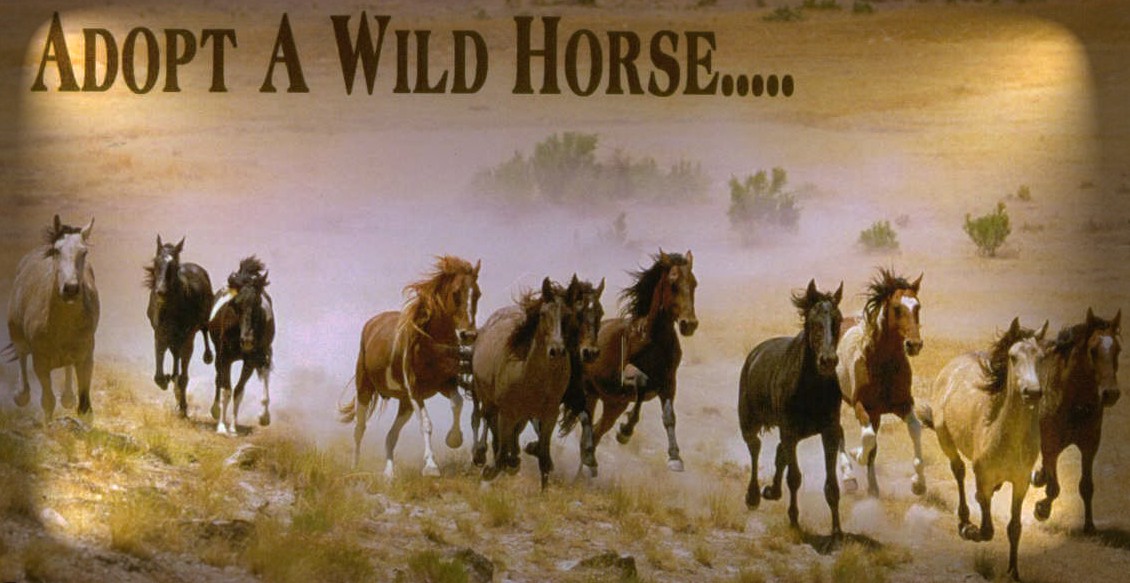
Several programs have been developed that provide equine therapy for prisoners such as the Canyon City Prison Adoption Program (W.H.I.P) in Colorado and the Arizona Prison system Adoption Program.

But you don't have to be a convict or troubled youth to adopt! One organization that has promoted adoption is the Extreme Mustang Make-overs. They sponsor a contest each year in which trainers can adopt, train over a three month period, and sell, a mustang. For more information on their program go to their website: http://extrememustangmakeover.com/

You can also adopt right from the BLM. Go to this link: https://www.blm.gov/adoptahorse/

If you are interested in reading "In the Heart of a Mustang," a book that will touch your heart, go to the website: www.dancinghorsepress.com 
It is also available on Amazon and for Kindles.

Literary Classics Awards said of this book: "In the Heart of a Mustang is one of the finest books ever written for teens and pre-teens."

Wednesday, November 9, 2016

GOODREADS GIVEAWAY FOR THE STONE OF MERCY

Great News!
Goodreads.com is offering 3 free (as in really free!) copies of The Stone of Mercy. You must go to the link below and click on the box that says "Enter Giveaway" between November 9th and December 9th for a chance to win. It would make a great Christmas gift for yourself or a friend!

Click here: https://www.goodreads.com/book/show/31329421-the-stone-of-mercy?from_search=true

Monday, October 31, 2016

HAPPY HALLOWEEN UNICORN STYLE

Happy Halloween from unicorn Jazz!
(Jazz is the star of The Mist Trilogy)

Wednesday, October 5, 2016

THE STONE OF MERCY HAS BEEN RELEASED!

I am sorry that I haven't written a post for over a month! I have been so busy with the October 1st release of my newest book. I'm excited about it and am sure you will enjoy it. "The Stone of Mercy-Book 1 of the Centaur Chronicles" is the first of a 4 book series about the land of Crystonia and the Centaurs, Cyclops, Ogres and little Deunde who inhabit it. Crystonia has been without a leader for a century and a half while the larger races battle for the throne. However, by tradition, the ruler will be the one who wears the Silver Breastplate. No one expected that the breastplate would be given to a young Duende girl, however. 


The Stone of Mercy received an excellent review from Feathered Quill and they followed up the review by interviewing me. Here is the text of the interview:

Author Interviews

Today, Feathered Quill reviewer Kristi Benedict is talking with M.J. Evans, author of The Stone of Mercy: Book 1 of the Centaur Chronicles
FQ: What was your inspiration for the several different races in this book?
EVANS: I selected races (or species) that would reflect different and competing traits. Some of the traits would logically be held by people hungry for power. For example, the cyclops are not known for their intelligence. Rather, they rely on brute strength. The Centaurs have speed and fighting ability but do so with more finesse and intelligence. The Duende are a made up race taken from the Spanish word that means fairy. They represent the weaker, over-looked and taken for granted species. The fauns, by tradition, have a fun-loving, irresponsible nature. So they were the obvious ones to sell their souls to the Cyclops for protection and then find themselves enslaved.
FQ: Did you do any research on Greek mythology to write about the centaurs, cyclops, etc?
EVANS: I did very little research on the mythology around centaurs, cyclops and fauns because I wanted to create new and unique characteristics in my characters. If I did too much research, that might stifle my creativity. There are many mythological creatures based upon a horse. I think this is because people have always loved and revered horses. I am one of those people. All, but one, of my novels have a horse connection and I love to use the mythological horses as my main characters, however, always with a different twist. My first fantasy series, "The Mist Trilogy," is about the noble and great horses that are chosen to become unicorns when they die. My choice to create a series about Centaurs is a continuation of my love of writing about horses. It is fun for me to include horse behaviors and traits when I write about Tibbals and Tandum and the other Centaurs. Then I get to add human mannerisms as well.
FQ: What demographic were you aiming for with this book, pre-teen or young adult?
EVANS: I initially pictured my readers to be 10 to 14, so Middle-Grade. However, many adults have been enjoying it as well so perhaps it will be well received by young adults as well.
FQ: What is the reason for calling the series "The Centaur Chronicles?"
EVANS: "The Duende Diaries" just didn’t have the same ring to it! Just kidding. I teach English riding lessons and I am always telling my students to become a Centaur...to be one with the horse. After several years of using this phrase, I decided it was time to write a story about Centaurs.
FQ: What do you think are the advantages of using a young girl as your protagonist?
EVANS: As a small, delicate creature, she has an uphill battle to win over the larger races. The Silver Breastplate gives her an unexpected advantage and great power. But, remember, she never aspired to be the queen, consistent with both her station in life and her personality. But her personality is changing with each book of the series, keeping her good qualities but developing more confidence and commitment to her calling. I think it is fun to have a young girl in this position as many girls will be asked to accomplish great things in their lives whether it is to raise a strong family or run a country.
FQ: In the graphic scenes for this novel, such as the attack on the Duende village, how do you decide what details to include so the scene is still powerful but not too overly graphic?
EVANS: I like this question because this is one that I struggle with all the time. The second book has some battle scenes in it as well as will the fourth. I try to picture a PG movie as I write. I want to write books that leave a good message but that are exciting. So it is a challenge to balance both. Some fantasies are even too dark for me. I want to keep it light and fanciful even while describing a battle scene. I don’t want my readers to have nightmares!
FQ: Did your experience with horses help when writing about the centaurs in this novel?
EVANS:I mentioned this in the 2nd question. Yes, I love writing about horses and their personalities. It is so fun using the technique of Anthropomorphism in my writing. My brain just goes right to putting human characteristics on horses because I love them so much and am so familiar with them. For example, when a horse is irritated, he will swish his tail. I had the centaurs do this in the book. They stomp their hooves, rear and kick, just like a horse would.
FQ: Which part of the book did you enjoy writing the most, the beginning, the end, or a specific scene in the middle?
EVANS: I think my favorite scenes are any scene where the Wizard appears. I like that character. In addition, I had fun writing the scenes with the Commander at Fort Heilodius. The bad guys are fun to create!
To learn more about The Stone of Mercy: Book 1 of the Centaur Chronicles please read the review at: Feathered Quill Book Reviews.


The Stone of Mercy is available in Print only at the present time. It is available on Amazon,
Barnes and Noble, and independent bookstores. 
Autographed copies are available on the website: www.dancinghorsepress.com
Just click here:


Autographed copies are available on the website: www.dancinghorsepress.com

Thursday, August 4, 2016

THE LEGEND OF BABIECA


Perhaps the day of the war horse is gone but their legends live on. This is true of Babieca (there are numerous spellings!) the mount of the famous, or "infamous" depending upon the source, El Cid.

El Cid who lived from approximately 1043 to 1099, was the son of minor nobility in medieval Spain. He was raised in the court of King Ferdinand the Great and was a servant to the king's son. He became a renowned, feared and beloved war hero as he battled for the Spanish cause of expanding their territory. To this day, El Cid, full name Rodrigo Diaz de Vivar, is a Spanish folk hero and national icon. He is the subject of numerous plays, poems, and paintings.


But what of the horse? El Cid's favorite horse was Babieca, a white Andalusian Stallion. No one really knows the history of how they came to be battle partners. One story has it that El Cid was offered his choice of any of the horses in the herd of Andalusians by his godfather, a monk at a Carthusian monastery.  He chose the littlest, weakest one. His godfather thought it was such a poor choice that he exclaimed "Babieca!" which means "Stupid." 

Another story is that El Cid was given the horse by King Sancho when El Cid was challenged by another Knight to become the king's champion. The story goes that Babieca was bred and raised in the royal stables in Seville and was a highly trained and loyal war horse when El Cid got him.

Whatever the truth, El Cid loved the horse and even requested that they be buried together. 

A little side note: Did you know that our modern day discipline of Dressage has its origins in the training of War Horses?


Check out my new website for my books: www.dancinghorsepress.com

Sunday, July 10, 2016

IN THE HEART OF A MUSTANG WINS THE GOLD MEDAL FROM THE LITERARY CLASSICS AWARDS!

On July 1st, it was announced that In the Heart of a Mustang was the first place, gold medal winner, of the Literary Classics Award in the Young Adult General Fiction category. Literary Classics, an organization dedicated to furthering excellence in literature, takes great pride in its role to help promote classic literature which appeals to youth, while educating and encouraging positive values in the impressionable young minds of future generations. Judging is based upon the criteria set forth by Literary Classics' highly selective awards committee which honors books promoting character, vision, creativity and learning, through content which possesses key elements found in well-crafted literature.

In their review they wrote: "In the Heart of a Mustang is one of the finest books ever written for teens and pre-teens. This book is strongly recommended for young readers."

I am so honored by this award. I will be going to their formal award ceremony in Las Vegas on October 14th and doing a book signing with the other award winners on October 15th.


If you would enjoy reading In the Heart of a Mustang, it is available on the website: www.dancinghorsepress or wherever books are sold. Autographed copies are available only on the website or at book signings. It is also available as an ebook through Amazon.


Saturday, June 18, 2016

IN THE HEART OF A MUSTANG EARNS MORE ACCLAIM!

I am so excited to announce that Literary Classics, an organization that picks the best children's and young adult books for the year, has selected "In the Heart of a Mustang" as one of their finalists for the 2016 young adult category!

In their review they said: "In the Heart of a Mustang is one of the finest books ever written for teens and pre-teens. We strongly recommend it!"

I am really excited about this book and it is fun to have critics love it as well!

If you would like to get a copy for yourself go here:

Also available in ebook version and wherever books are sold.